In biomedical research, the terms in vitro, in vivo, and in silico describe different ways of studying biological systems. These terms are not interchangeable. Each refers to a distinct experimental context, with its own strengths, limitations, and role within the research pipeline.
Together, they form a complementary framework that allows scientists to investigate biological questions at different levels, from isolated molecules to whole organisms and computational models.
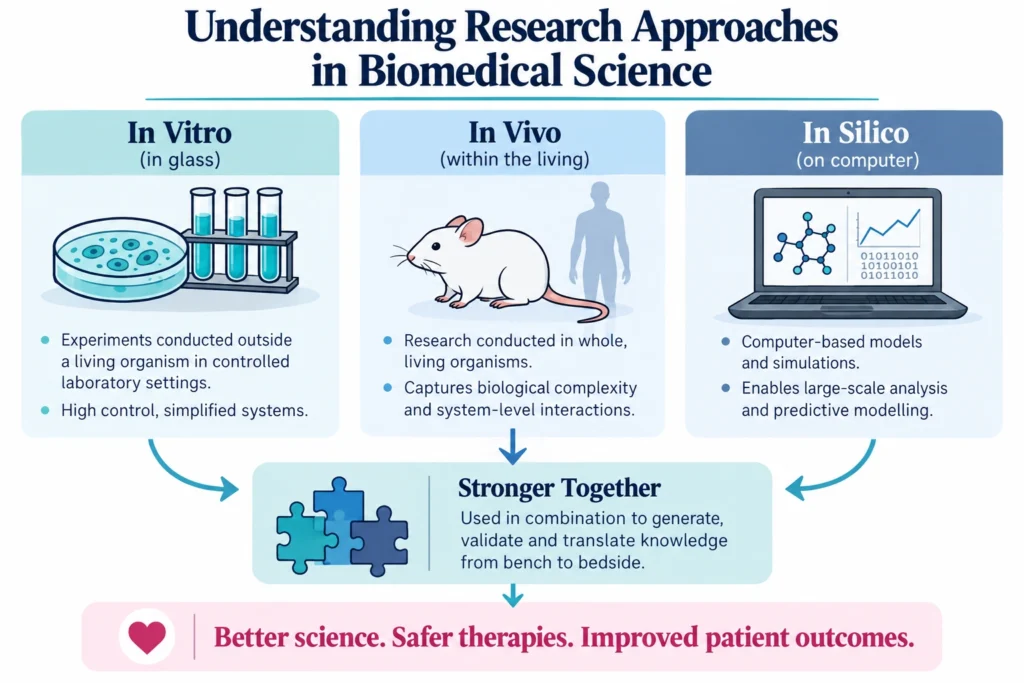
“In vitro” is Latin for “in glass.” It refers to experiments conducted outside of a living organism, typically in controlled laboratory environments such as test tubes, petri dishes, or cell culture systems.
In vitro research often involves studying cells, tissues, or biological molecules in isolation. For example, researchers may grow human cells in culture to examine how they respond to a drug or study how a specific enzyme functions under controlled conditions.
The key advantage of in vitro studies is the ability to control conditions. Researchers can isolate variables, manipulate conditions precisely, and observe specific biological processes without the complexity of an entire organism. This makes in vitro methods particularly useful for early-stage research, including drug screening and mechanistic studies.
However, because these systems are simplified, they do not fully replicate the complexity of a living body. Results obtained in vitro may not always translate directly to real-world biological systems.
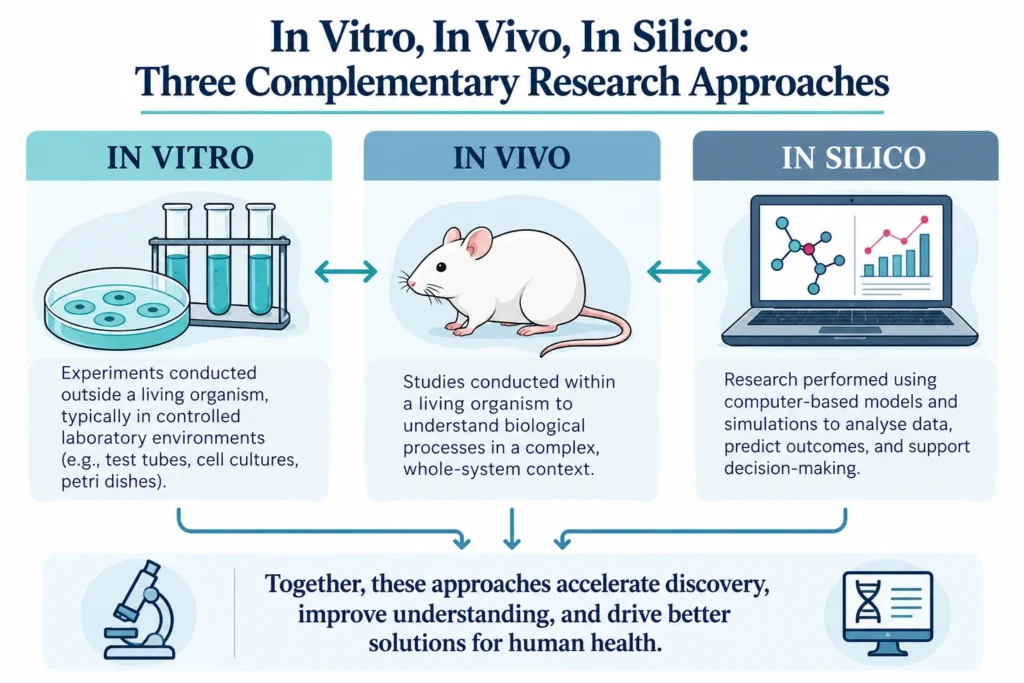
“In vivo” means “within the living.” It refers to research conducted on whole, living organisms. This may include animal studies or, in later stages of research, human clinical studies.
In vivo research allows scientists to observe how biological processes occur in the context of a complete organism, where multiple systems interact. This includes studying how a drug is absorbed, distributed, metabolised, and eliminated, as well as its overall effects on health and disease.
The strength of in vivo research lies in its realism. It captures the complexity of living systems, including interactions between organs, immune responses, and long-term effects.
However, this complexity also makes in vivo studies more difficult to control. They are typically more resource-intensive, subject to ethical regulation, and may still not fully predict human outcomes when animal models are used.
“In silico” refers to research conducted using computer-based models and simulations. The term reflects the use of silicon-based computing systems.
In silico approaches include computational modelling, data analysis, and simulations of biological processes. For example, researchers may use computer models to predict how a drug will bind to a target protein, simulate disease progression, or analyse large datasets from genomic studies.
One of the key advantages of in silico research is scalability. It allows the analysis of large volumes of data and the exploration of scenarios that would be difficult or impossible to test experimentally. It is also faster and often less costly than laboratory or in vivo studies.
However, in silico models are only as accurate as the data and assumptions on which they are based. They require validation through experimental methods to ensure that predictions reflect real biological behaviour.
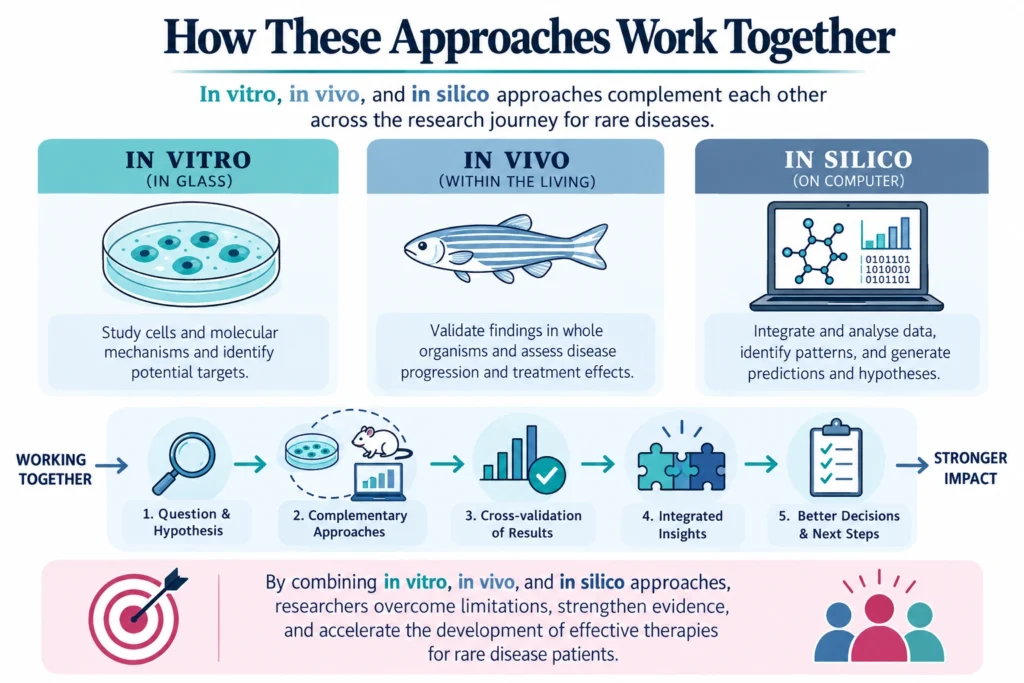
In vitro, in vivo, and in silico methods are not competing approaches. They are complementary and are often used sequentially or in combination.
A typical research pathway might begin with in silico modelling to identify potential drug targets or predict molecular interactions. This may be followed by in vitro experiments to test these predictions in controlled laboratory settings. Promising results can then be evaluated in vivo to assess how the intervention performs in a whole organism.
This integrated approach improves efficiency and reduces risk. It allows researchers to filter and refine hypotheses before moving to more complex and resource-intensive stages.
Each research method has distinct strengths. In vitro studies offer precision and control. In vivo studies provide biological relevance and system-level insights. In silico methods enable large-scale analysis and predictive modelling.
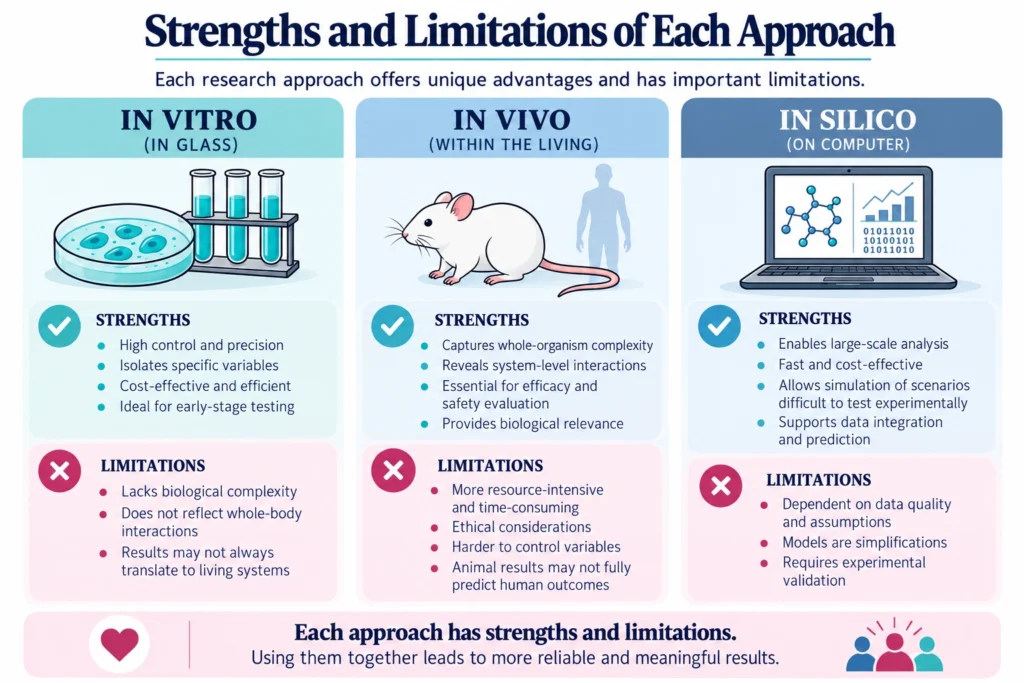
At the same time, each has limitations. In vitro systems lack complexity. In vivo studies are resource-intensive and may not fully translate to humans. In silico models depend on data quality and assumptions.
Understanding these strengths and limitations is essential for interpreting research findings and assessing their reliability.
In rare diseases, these approaches are particularly important due to limited patient populations and data availability.
In vitro models, such as patient-derived cells, allow researchers to study disease mechanisms at a cellular level. In vivo models, including genetically modified animals, help investigate how these diseases affect the whole organism. In silico methods can integrate data from multiple sources to identify patterns, predict outcomes, and guide research priorities.
The combination of these approaches helps overcome some of the challenges associated with studying rare conditions.
The use of in vivo methods, particularly involving animals, is subject to strict ethical regulation. Researchers are encouraged to use alternatives where possible and to minimise the number of animals used.
In vitro and in silico methods are increasingly used to reduce reliance on animal studies. Advances in technologies such as organoids and computational modelling are expanding the capabilities of these approaches.
However, at present, no single method can fully replace the others. Each provides a different type of insight, and together they contribute to a more complete understanding of biology.
Understanding the difference between in vitro, in vivo, and in silico research is important for interpreting scientific studies and medical developments. These terms indicate the context in which research was conducted and help determine how findings should be evaluated.
For example, results from an in vitro study may be promising but require further validation. In vivo results provide stronger evidence but still need confirmation in human studies. In silico predictions can guide research, but must be tested experimentally.
Recognising these distinctions supports a more accurate interpretation of scientific evidence.
These three approaches represent a structured way of investigating complex biological questions. They allow researchers to move from controlled, simplified systems to more complex and realistic contexts, while also leveraging computational power to guide and refine research.
In modern biomedical science, progress depends on the effective integration of in vitro, in vivo, and in silico methods. Each contributes a different perspective, and together they form the foundation of how new knowledge is generated and translated into clinical practice.