Whole genome sequencing is a term being widely used in medicine, research, and the media. However, many people don’t fully understand what it means, and it can be complicated, especially for patients or families dealing with rare or complex health conditions.
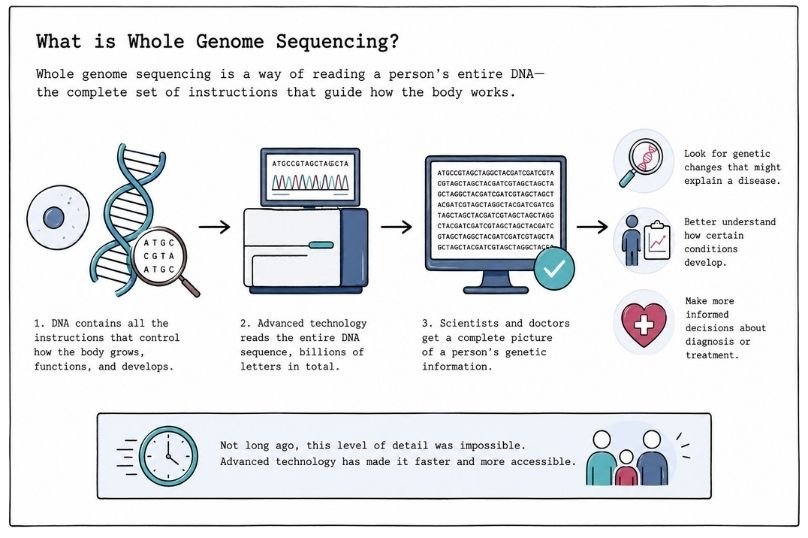
At its simplest, whole genome sequencing is a way of reading a person’s DNA. DNA contains all the instructions that control how the body grows, functions, and develops. By examining the entire DNA sequence, scientists and doctors can obtain a complete picture of a person's genetic information.
This is important because it allows doctors to look for genetic changes that might explain a disease, provide a better understanding of how certain conditions develop, and make more informed decisions about diagnosis or treatment.
Not long ago, this level of detail was impossible. Advanced technology has made it faster and more accessible.
The genome is the complete set of DNA in a person. It contains all the genetic information needed for the body to function.
Human DNA is organised into 23 pairs of chromosomes, and together they contain about 3 billion DNA “letters”. These letters make up genes, which carry instructions for making proteins and other regions that help control how and when genes work. All of this information tells cells how to grow, function, and respond to the environment.
Whole genome sequencing (WGS) is a test that reads all of a person's DNA, letter by letter. Instead of examining just a few specific genes, it examines the entire genome to capture nearly all genetic differences in a person.
This is what makes WGS different from other genetic tests, as some tests only look at specific genes or small sections of DNA, while whole genome sequencing looks at everything at once
Sequencing means figuring out the exact order of DNA letters in a sample.
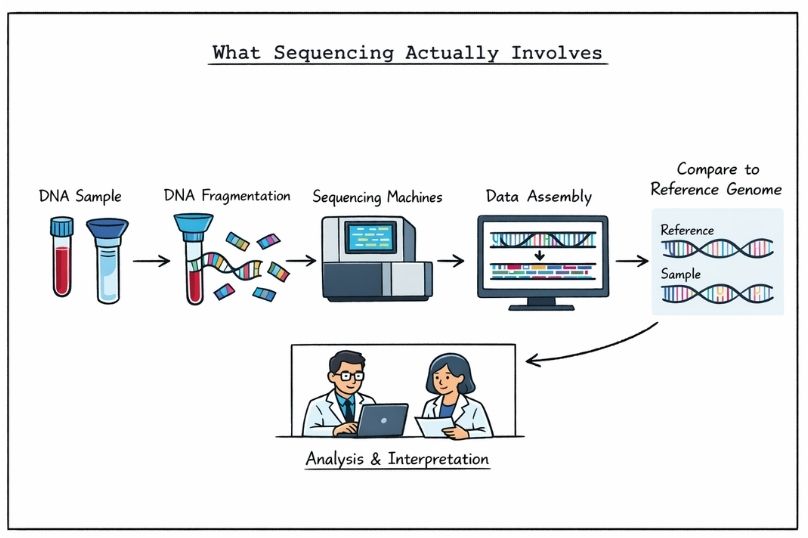
In whole-genome sequencing, DNA is taken from a sample, usually blood or saliva. Then, the DNA is broken into many small pieces. Machines read these pieces simultaneously, producing a large volume of data. After that, powerful computer programs put the pieces back together by comparing them to a reference (a standard human genome) to identify any differences between the person’s DNA and the reference.
These results are large and complex and require experts to analyse and interpret them.
Genetic tests vary, so it's important to understand the purpose of whole genome sequencing.
Some tests examine only part of the DNA or a single gene related to the suspected condition. Exome sequencing examines only protein-coding regions, which are a small part of the genome.
Whole genome sequencing examines the entire DNA of the genome, including both coding and noncoding regions.
This can be used to test a wide range of genes, detecting variation that might be missed by other tests, giving a clearer view of a specific gene.
Whole genome sequencing is commonly used in rare diseases and also in patients with cancer.
In rare diseases, symptoms are sometimes unclear, involving different body systems or evolving features. Targeted tests are more likely to miss unexpected or novel genetic causes.
This allows clinicians and researchers to take a broad, unbiased approach. They can check what genetic differences exist, which may explain the clinical features.
In addition, it is used in research to identify novel genetic causes of rare diseases or to characterise mutational signatures associated with some types of cancer.
Whole genome sequencing can detect any genetic variation in a patient's DNA.
This includes small changes in a single DNA letter, insertions or deletions in which small DNA segments are added or deleted, and larger variations such as duplications, deletions, or rearrangements of DNA segments.
This can help to detect variations in regulatory regions that affect how genes are controlled rather than how proteins are made.
The importance of that technology increases the chances of finding the cause of disease, especially in complex or previously unexplained cases.
Although whole genome sequencing can read all of your DNA, it has its limitations.
Not all genetic variants automatically mean it’s a disease. Most variants are harmless, and others aren’t well understood. In addition, understanding it depends on the current scientific knowledge, which is evolving.
Whole genome sequencing also cannot accurately predict all future health problems, which depend on other important factors such as environmental factors, lifestyle and chance.
Also, doctors still need to review your symptoms, medical history, and clinical features, which are essential for accurate interpretation.
Genome sequencing is a powerful tool, but it's only part of the puzzle for understanding, not predicting your long-term health.
The output of whole genome sequencing is a detailed map with a list of genetic variants that needs a skilled navigator.
Others are well established as harmful variants. Some are known to be benign variants. But many will fall in a category called variant of uncertain significance, meaning there is not enough evidence to determine their impact.
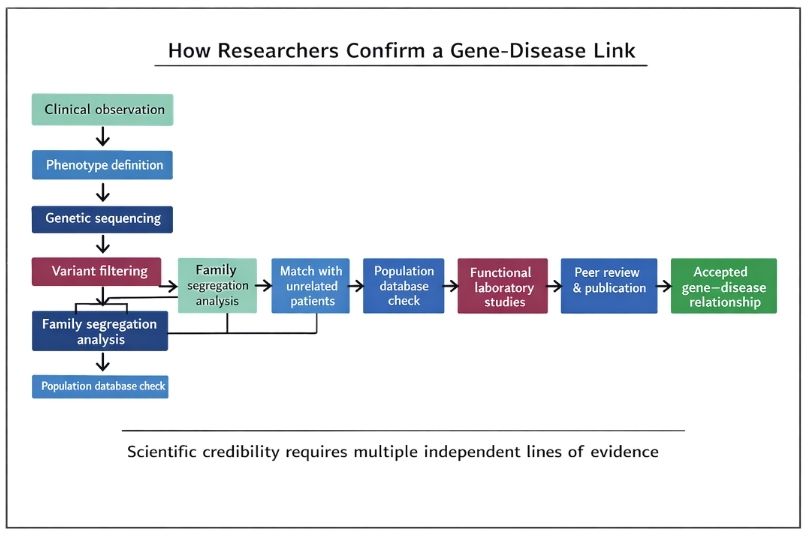
This is where clinical genetics uses gene sequencing in real life. Clinicians and scientists consider how a variant affects a gene, whether it has been reported before, its prevalence in the population, and whether it matches the clinical picture.
Genetic sequencing isn't a yes-or-no question; it's an evolving science, and every new piece of information available today leads to greater understanding in the future.
In clinical practice, whole genome sequencing is increasingly used when standard investigations have not yielded a diagnosis.
It is particularly valuable in rare diseases, paediatrics, and complex multisystem conditions. In some cases, it leads to a clear diagnosis that changes management, informs prognosis, or guides treatment.
In other cases, it provides partial answers or narrows possibilities rather than delivering certainty. Even when no definitive diagnosis is found, the data may remain useful for future reanalysis as knowledge advances.
Whole genome sequencing is therefore best viewed as part of an ongoing process rather than a one-time test.
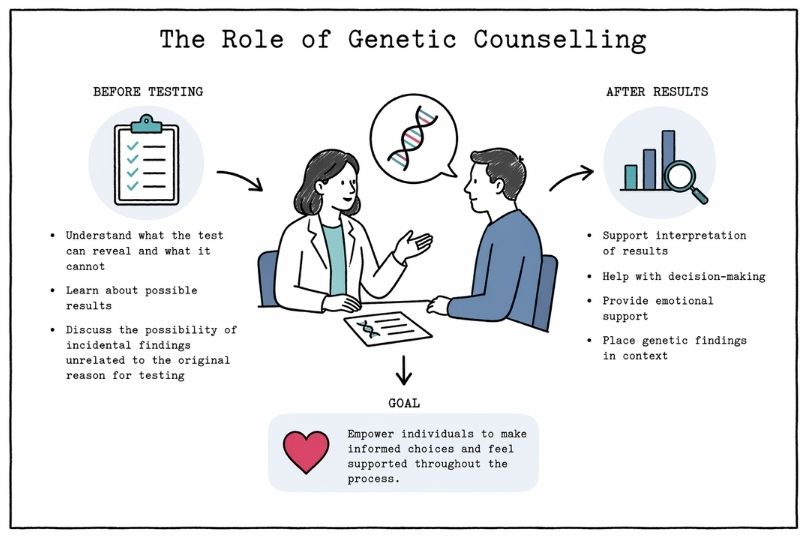
Because whole genome sequencing generates complex and sometimes unexpected information, genetic counselling is essential.
Counselling helps individuals understand what the test can reveal, what it cannot, and what types of results might emerge. This includes the percentage of incidental findings unrelated to the original reason for testing.
After results are available, counselling supports interpretation, decision-making, and emotional processing. It helps place genetic findings in context rather than allowing them to be misunderstood or overinterpreted.
Whole genome sequencing may identify new gene–disease links that are discovered and not related to the initial diagnosis.
These are known as incidental or secondary findings. Some may have health implications, while others may not. Policies differ on what is reported and how consent is handled.
This aspect of whole genome sequencing raises important ethical considerations. Individuals should understand in advance what types of findings they may receive and have a say in what information they wish to receive.
Transparency and choice are central to ethical use of sequencing.
Whole genome sequencing generates an enormous amount of data.
Storing, analysing, and protecting this data requires robust infrastructure. Privacy and data security are critical, as genetic data is uniquely identifying.
In rare disease research, data are often anonymised and shared to advance knowledge. In clinical care, access is tightly controlled. Balancing data sharing with confidentiality is an ongoing challenge in genomics.
Understanding this context helps explain why sequencing results are handled carefully and why access may be restricted.
In research, whole genome sequencing has transformed understanding of human biology and disease.
It allows scientists to identify new genetic causes of disease, uncover factors that influence the severity of a condition, and explore why the same condition can affect individuals differently.
Large-scale sequencing projects have revealed that genetic variation is far more complex than once thought. This has challenged simplistic ideas about genes and disease, replacing them with more refined models.
Research findings eventually feed back into clinical care, improving diagnosis and interpretation over time.
One important feature of whole genome sequencing is that results can be revisited.
Because the data capture the entire genome, they can be reanalysed as scientific knowledge advances. New disease-gene links may emerge years after the original test.
This makes whole genome sequencing particularly valuable in conditions where answers are not immediately found. The data remain relevant, even if interpretation changes.
Reanalysis turns sequencing from a single event into a long-term resource.
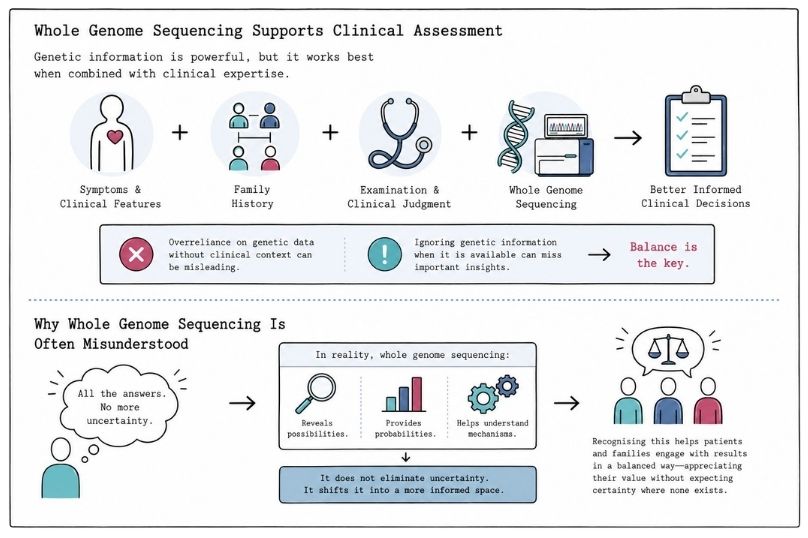
It is important to emphasise that whole genome sequencing supports clinical assessment.
Symptoms, clinical features, family history, and examination remain essential. Sequencing adds a powerful tool of information, but it does not function alone.
Overreliance on genetic data without clinical context can be misleading. Conversely, ignoring genetic information when it is available can miss important insights. Balance is the key.
Whole genome sequencing is sometimes presented as definitive or all-knowing. This creates unrealistic expectations.
In reality, it is a tool that reveals possibilities, probabilities, and mechanisms. It does not eliminate uncertainty. It shifts it into a more informed space.
Recognising this helps patients and families engage with results in a balanced way, appreciating their value without expecting certainty where none exists.
Whole genome sequencing is becoming faster, more affordable, and more integrated into healthcare.
As knowledge improves and data accumulate, its clinical impact will continue to grow. At the same time, ethical considerations, communication, and support will remain just as important as technology.
Whole genome sequencing means reading the full genetic instruction manual. What matters is how that information is understood, communicated, and used.
Used thoughtfully, it offers clarity without overpromise and insight without determinism. It is a powerful tool, not an answer in itself.