Small molecule treatments are used across many areas of healthcare, including cancer, autoimmune disease, metabolic disorders, and an increasing number of rare conditions. Despite their widespread use, the term “small molecule” can sound abstract or technical, making it difficult to understand what these treatments actually are and how they work.
A small molecule is a chemical compound with a low molecular weight. These molecules are small enough to easily enter cells and interact with targets inside the body.
In medicine, small molecule drugs are chemically manufactured and often have very simple structures that can be modified and designed to meet specific therapeutic goals. They represent 80-90% of therapeutics that exist in the market today.
Common examples of small molecule drugs outside rare disease include aspirin, statins, and many oral cancer therapies. In rare disease, small molecules may target specific enzymes, pathways, or metabolic processes that are disrupted by a genetic condition.
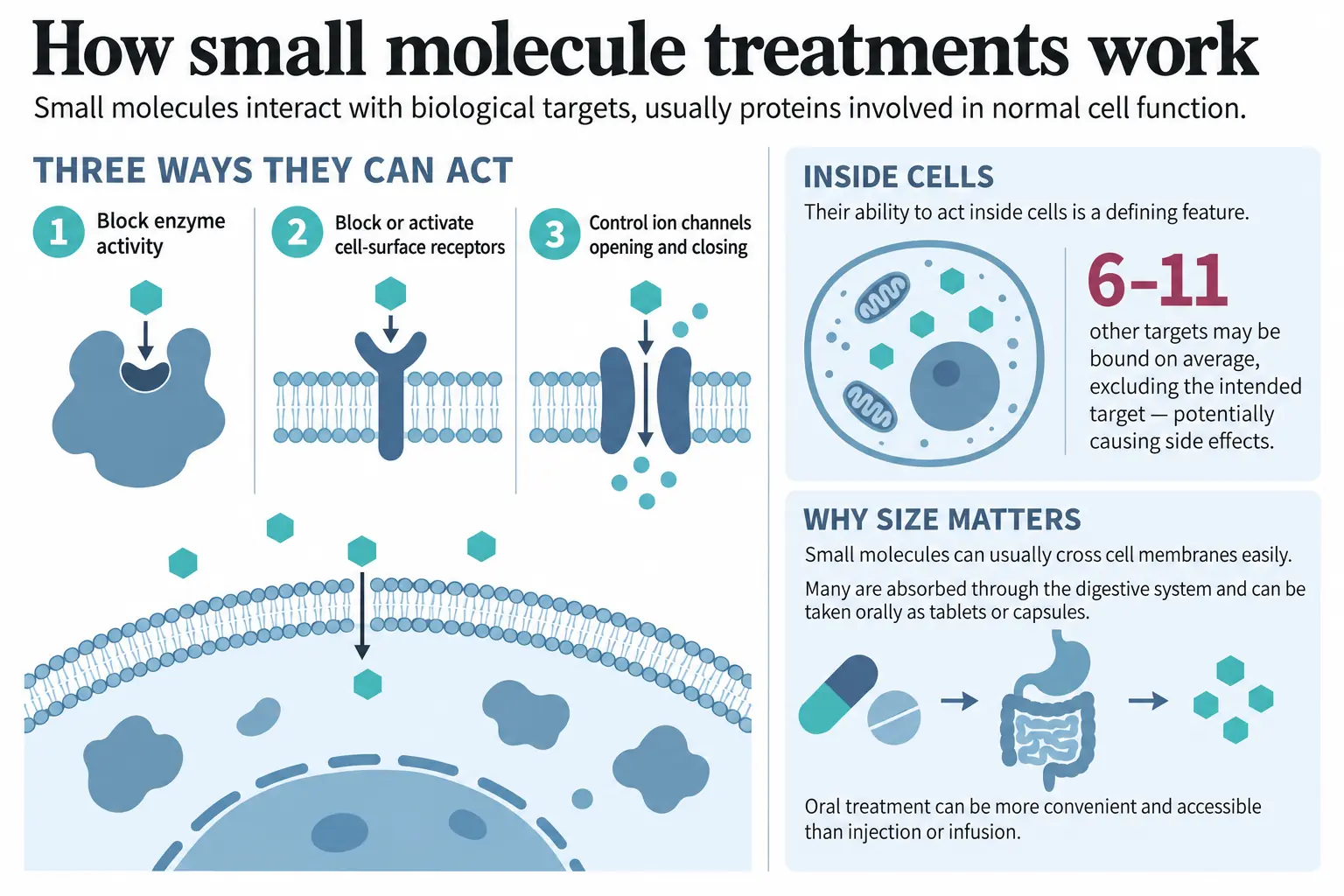
Small molecule treatments work by interacting with biological targets, usually proteins that play a role in normal cellular function. They go through several stages in the body which can influence how quickly they will work, how long they will last in the body and how often they need to be taken.
Small molecule drugs can elicit a therapeutic response in a number of ways, this includes:
1) Blocking enzyme activity
2) Blocking or activating receptors which are proteins on the surface of cells
3) Control the opening and closing of ion channels
The ability to act inside cells is one of the defining features of small molecule treatments and a key reason they are widely used. However, small molecule drugs can bind 6-11 other targets on average, excluding their intended target, this can result in potential side effects.
The size of small molecule drugs has direct consequences for how the drug behaves. Small molecules are usually able to cross cell membranes easily because of their size.
They are also typically absorbed through the digestive system, which means many small molecule treatments can be taken orally as tablets or capsules. This is a more convenient and accessible treatment option compared with therapies that require injection or infusion.

Small molecule drug development begins by using bioinformatic techniques to identify biological targets like specific proteins or genetic elements that play a critical role in the development of the disease. Researchers then screen large numbers of compounds to find those that interact with that target.
Promising candidates are refined to improve specificity and safety. The structures of these small molecules are optimized further through additional biological testing. Preclinical testing examines how the drug behaves in cells and animal models.
Clinical trials then assess safety, dosing, and effectiveness in people. In rare disease, these trials are often small and are reflective of limited patient populations.
Small molecule treatments are often compared with biologic therapies, which differ significantly in size, structure and how they act on the body. Biologics are larger, more complex molecules that are derived from living cells or through specific biological processes. Examples of biologics include vaccines, insulin, or hormonal therapies.
Biologics usually act on targets outside cells, such as receptors on the cell surface or circulating proteins. They are much more sensitive to specific manufacturing processes, and temperatures making them more unstable than small molecule drugs. Small molecule treatments tend to have broader distribution in the body, and do not typically trigger immune responses which can be an advantage or a challenge depending on the condition being treated.

Both approaches to treatment can be beneficial, however, in rare disease, the choice between a small molecule and a biologic depends on the underlying biology of the condition. Understanding how different treatment types work and can complement each other helps set realistic expectations and supports informed decision making.
When it comes to rare diseases, there are instances where a specific treatment type may not address a condition in its entirety. As such, small molecule treatments can be used to enhance the effect of another therapy or manage symptoms rather than the underlying cause of a disease.
Many rare diseases are caused by defects in enzymes or metabolic pathways. Small molecule treatments are well suited to addressing these problems because they can directly influence these pathways. In some cases, a small molecule can compensate for a missing or dysfunctional protein by enhancing an alternative pathway or reducing the accumulation of toxic substances.
For rare diseases, small molecule treatments are particularly important due to the ease of administration and manufacturing compared to biologics like gene or cell based therapies. They allow for multiple administration methods, easy to scale and relatively low cost. The ability to reach multiple tissues within the body makes this treatment modality more suitable for rare diseases that impact multiple organs.In some rare diseases, small molecules are used to manage symptoms while more targeted therapies are in development, while for others they can be the main treatment option.
Small molecule treatments can be used to treat a multitude of rare conditions such as:
1) Metabolic disorders in which the treatments can reduce the build up of harmful metabolites. For example, Nitisnone which is used in the treatment of a rare metabolic disorder known as Hereditary Tyrosinemia Type 1.
2)In certain genetic conditions, they may act as chaperones, helping misfolded proteins maintain a functional shape.
3) In some rare diseases, small molecules may inhibit or promote signalling pathways that either work to decrease or increase protein production. For example, Risdiplam which used as a treatment for Spinal Muscular Atrophy and works to increase the amount of Survival Motor Neuron Protein.
While these approaches do not cure the underlying genetic cause, they can meaningfully alter disease course or symptom burden.
Small molecule treatments offer several practical advantages making them a popular treatment option for rare diseases. For example, most small molecule treatments are administered orally. This improves accessibility and patient adherence, especially when used for treatment of long-term conditions.
Furthermore, these treatments are chemically stable and do not require specific storage conditions. This allows for easier distribution and access globally. Manufacturing processes for small molecules are generally well established. This can make scaling production more feasible once a treatment is approved.
Since small molecules are structurally simple, and can be easily modified, their structure can be altered to improve effectiveness, reduce side effects, or modulate the way they are processed in the body.
Despite their advantages, small molecule treatments have limitations that should be considered. Small molecule treatments are designed to interact with specific proteins or pathways in the body. However, their size and ability to interact with additional targets has the potential to cause off-target toxicity, and unexpected side effects.
Small molecule drugs are also metabolized and excreted quickly by the body which can limit how effective they are and may require frequent doses to maintain their efficacy. These treatment types do not replace or repair genes that have errors, rebuild damaged tissues, or permanently correct the underlying cause of the disease.
In the context of rare disease, developing small molecule treatments can be challenging. The prevalence of these diseases is low, making it difficult to conduct clinical trials. Many rare diseases are not well understood, and genetically complex thus require extensive research to identify the correct targets for therapies.
Regulatory agencies recognize that the standards designed to protect public health can also hinder entry pathways for novel drugs. Thus various governments have created a variety of policies and adapted pathways to encourage the development of small molecule drugs for rare diseases that meet a serious unmet need. An example of this is the Orphan Drug Act in the United States of America.
Frameworks for regulatory drug approval, especially for rare diseases must ensure that patient safety is prioritized while also demonstrating treatment efficacy. Drug development for rare diseases is particularly challenging due to low disease prevalence, limited understanding of the disease and differences in how the disease presents in each individual.
The long term safety of rare disease treatments like small molecules is relatively uncertain and is related to the challenges associated with their development. This makes post approval monitoring extremely critical for patient safety, as real-world use of these drugs can reveal additional effects that may not have been seen in clinical trials. For example, a study on post-approval safety of rare disease medicines in the United States revealed that approximately 70% of FDA approved drugs had safety label changes, thus highlighting the value of regulatory monitoring once a drug is approved for use.
Decision making regarding the most appropriate treatment option can be difficult, however, it is helpful to know whether a a treatment is a small molecule drug, and the impact this has on the level of care patients require. These medications can often be oral, require frequent dosing and can interact with other drugs leading to unwanted side effects.
When discussing treatment options, you can engage in shared-decision making with your care team and ask questions regarding:
1) How the dug works in the body
2) What is the drug targeting
3) What is the dosing frequency and how long you would need to take the treatment for
4) What the side effects are of the treatment
5) Whether the drug interacts with specific supplements or other prescriptions you may be taking.
It is important to remember that small molecule treatments are one part of a broader therapeutic landscape. They may be used alone or in combination with other approaches such as biologics, gene therapies, or supportive care. Being informed supports shared decision making and realistic expectations about what a treatment can achieve.
Drug discovery and development has continued to evolve as patients' medical needs grow. While innovative treatment options like gene and cell therapies advance, small molecules are still an essential part of modern drug discovery research. A comparative study on biologics and small molecules states that even in today's drug market, small molecules consist of 90% of drugs sold in the global market.
Additionally, genetic or targeted biologic approaches may not be a suitable treatment option for all conditions. Patient access and tolerance towards novel therapeutic approaches must also be considered. Small molecules offer flexibility, scalability, and the potential for rapid adaptation through structure transformation as knowledge of the condition evolves.
Advancements in computer aided screening and technology has been pivotal for identifying and developing small molecule treatments for rare diseases. Together, these advancements ensure that small molecule treatments remain valuable in the field of modern therapies.
Small molecule treatments are chemically defined drugs that can enter cells and directly influence biological processes. Their size, stability, and versatility make them a cornerstone of modern medicine, including rare disease care.
Understanding what small molecule treatments are, what they can and cannot do helps demystify treatment options and places them in context alongside biologics, gene therapies, and other emerging approaches. For rare disease communities, this knowledge supports clearer communication, more confident shared decision‑making, and expectations grounded in how treatments actually work.
Small molecule treatments are not cures but they are a scalable tool within the broader landscape of therapeutics. As rare disease research advances and our understanding of the disease biology deepens, these treatments will play an important role in expanding options and improving care for people with rare conditions.