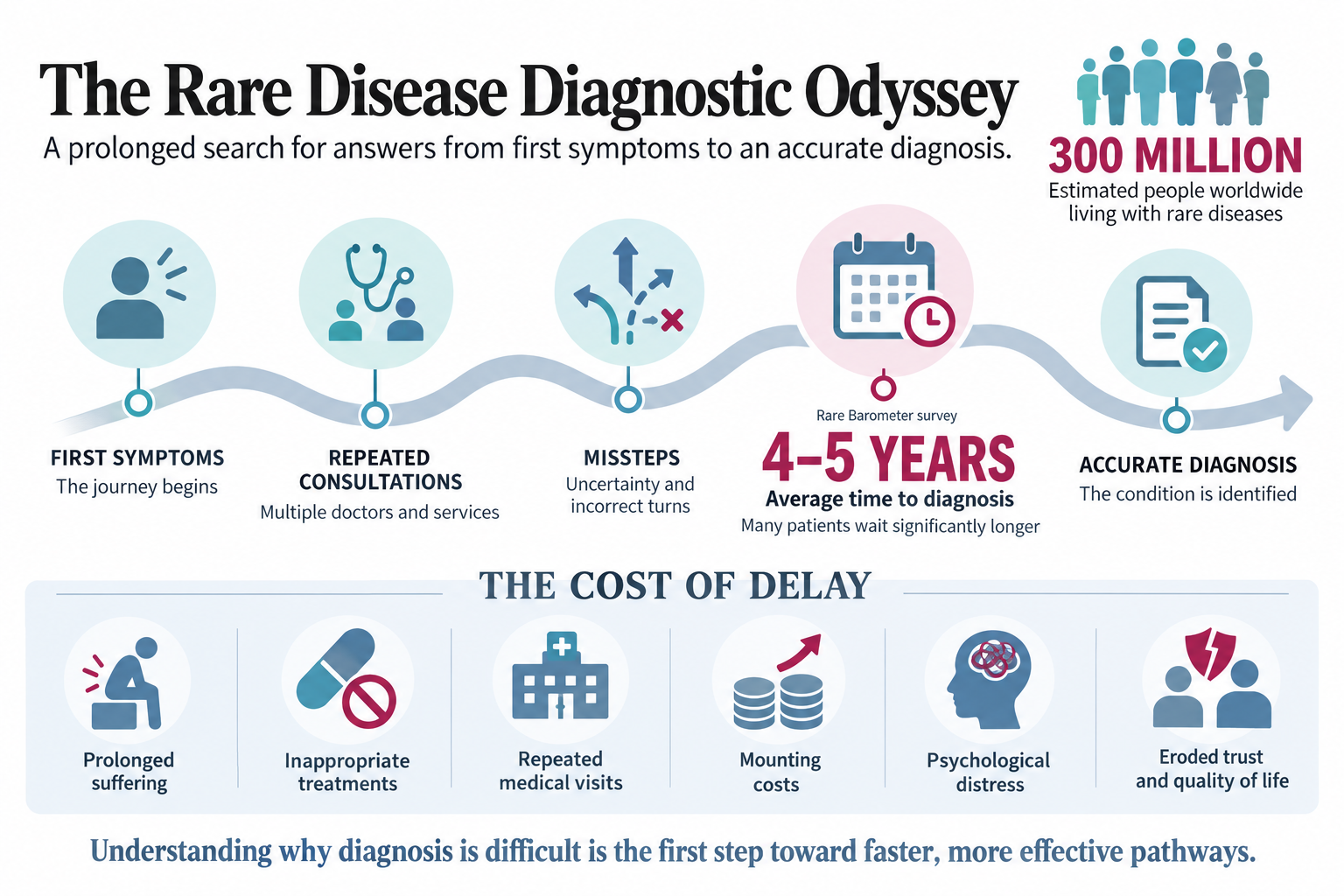
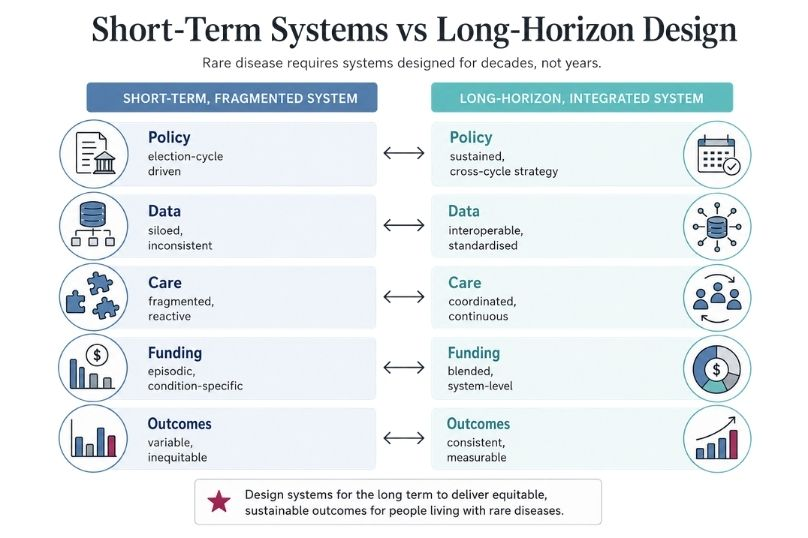
Families in many countries recognise the same frustrating pattern. A child with Down syndrome may have a paediatrician who focuses on health, a school that handles education planning, a social care team familiar with the family’s daily pressures, and a housing system that doesn't enter the conversation until much later. Each agency may function reasonably on its own. Yet when put together, they can still produce a fragmented experience that leaves families exhausted.
That fragmentation is one of the hardest policy problems in rare and lifelong conditions. It isn't only about clinical care. It's about whether public systems recognise that one person moves through many services across their lifetime, and whether those systems are designed to connect rather than divide. For readers following the broader rare disease field, our guide to rare disease definitions and prevalence explains why good system design matters just as much as getting the right diagnosis.
The UK's Down Syndrome Act has become a notable case study because it takes a different route from many disability or health laws, rather than promising a new treatment, benefit, or clinical pathway. Instead, it uses legislation to strengthen coordination through statutory guidance across public services. This approach may sound technical, but the underlying policy question is global. When a condition simultaneously affects health, education, social care, housing, and life transitions, how should a legal system respond?
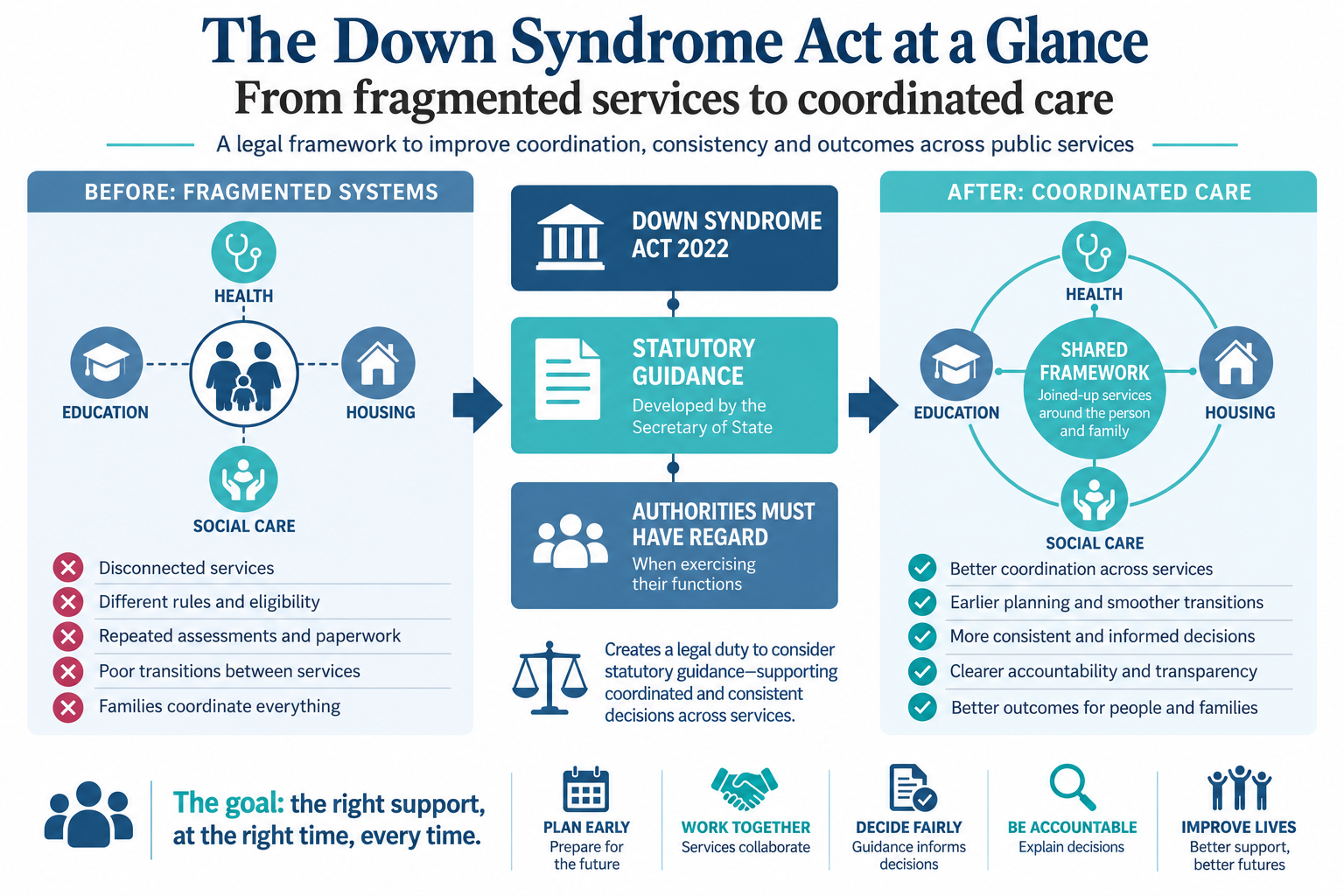
In many countries, families spend years repeating the same information to different agencies. A clinic knows the child's medical history. A school knows the communication profile. Social care knows the family's practical pressures. While housing services often know nothing until the person approaches adulthood. The burden of coordinating everything usually falls on the family rather than the state.
This pattern is not unique to Down syndrome, nor is it limited to the UK. It is common across rare diseases and lifelong conditions where needs cut across multiple public services and institutional boundaries. The policy significance of the Down Syndrome Act lies in how directly it targets that problem, by seeking to turn fragmented services into a more coordinated system.
The Down Syndrome Act is often discussed as a disability measure, but its broader significance lies in its role as a governance model. It raises a fundamental policy question. If public systems already have legal duties toward disabled people, why do families still experience inconsistency, poor transitions, and weak accountability?
Public systems rarely fail because there is no duty at all. They often fail because those duties sit in separate silos, with no effective way to translate them into a usable cross-service framework.
For global readers, this makes the law relevant beyond England. It offers a real-world example of a named-condition statute designed to improve implementation rather than rewrite every underlying entitlement. That approach is unusual, and it provides valuable lessons for advocates working on other rare conditions with lifelong, multi-agency needs.
The most interesting issue is not whether people with Down syndrome deserve attention. That's already clear from the lifelong nature of their support needs. The sharper question is whether legislation can genuinely drive better coordination across public services without claiming to solve every challenge at once.
This is why the Down Syndrome Act matters internationally. It provides a test case for a policy approach that many countries may eventually consider: using law not just to declare rights in principle, but to require public bodies to organise more effectively around a recognisable pattern of need.
Many countries grappling with similar challenges in rare and complex conditions may eventually look to this model for inspiration.
A family can move through years of coordinated support in childhood, only to face a far less predictable system in adulthood. Health services, education, social care, housing, and employment support often operate under separate rules, timelines, and eligibility thresholds. For people with Down syndrome, this institutional fragmentation was one of the main reasons the Down Syndrome Act was introduced.
The policy case was not built on abstract symbolism but on a recognisable implementation problem. Even though broad disability rights and service duties already existed, families and advocacy groups continued to report uneven access, inconsistent planning, and weak coordination across agencies. This recurring pattern helps explain why the Act attracts interest beyond the UK. It addresses a problem that appears in many countries where rare or lifelong conditions fall between general legal protections and the day-to-day reality of how public services are organised.
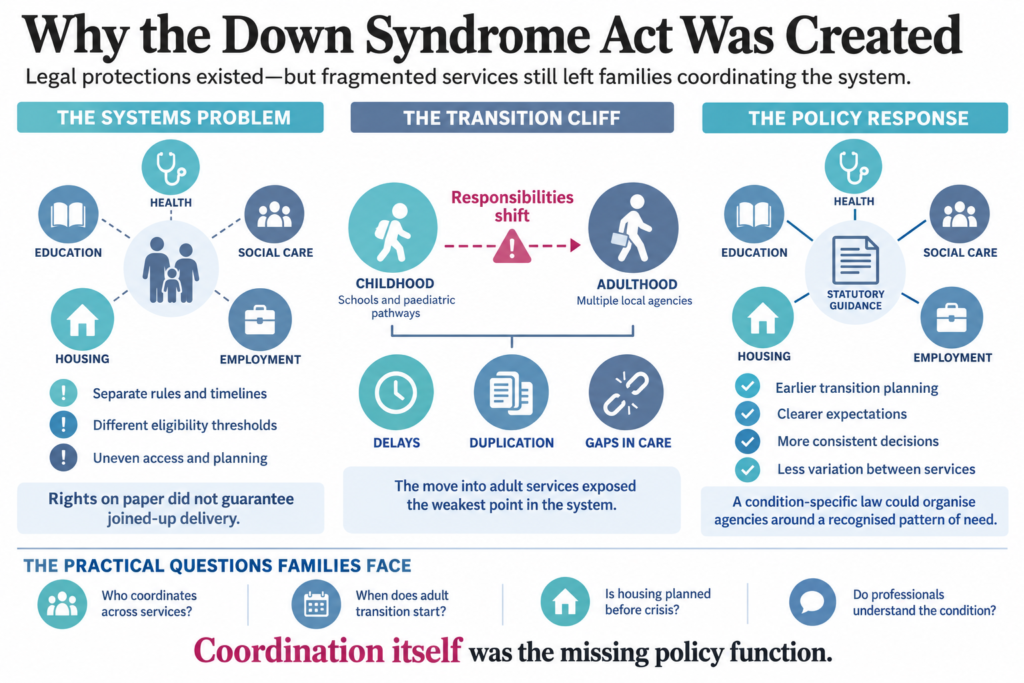
The transition from childhood to adulthood became a focal point because it exposes the weakest part of many support systems. Children are more likely to be connected to structured pathways through schools and paediatric care. In adulthood, support is often split across multiple local agencies, each with narrower mandates and different eligibility rules. The result is often delay, duplication, or sudden gaps in care.
This pattern is not unique to Down syndrome. It reflects a broader systems issue in rare and lifelong conditions, where institutional design matters just as much as formal rights written into law. As discussed in Rare Disease Watch’s analysis of rare disease as a systems challenge in policy, data, and care. The relevance here is straightforward: a person can have legal protections in theory and still encounter a poorly coordinated reality in practice.
Parliamentary debates and advocacy discussions consistently highlighted the transition from childhood to adulthood as a critical weakness in existing systems. The Down Syndrome Act was therefore designed to push public authorities toward earlier planning and more consistent decision‑making, especially at the point where responsibilities shift between child and adult services.
People with Down syndrome often require coordinated support across health, education, and social care throughout different stages of life. National Institute for Health and Care Excellence (NICE) Guideline NG213, which focuses on integrated service delivery for children and young people with severe complex needs, highlights the importance of this coordinated, cross-sector approach.
For lawmakers, the challenge was clear. General disability law can prohibit discrimination and establish broad duties, but it does not necessarily tell agencies how to organise around a known pattern of need. For families, the practical questions are administrative rather than theoretical:
A named-condition statute becomes politically plausible when the government accepts two propositions at once. Existing rights remain in place, but implementation is still inconsistent enough to justify a more targeted framework.
This is the deeper origin of the Down Syndrome Act. It was created to reduce variation between services, clarify expectations across public bodies, and turn a recognised pattern of need into something the government could address in a more organised and effective way. For global policymakers, the transferable lesson is clear. Rare disease legislation does not always begin with the creation of new rights. Sometimes it begins with the recognition that coordination itself is the missing policy function.
The Down Syndrome Act is best understood by looking at its structural design. In the UK, the Down Syndrome Act 2022 received Royal Assent on 28 April 2022, making it the first law in England to establish a condition-specific statutory framework requiring the Secretary of State to issue statutory guidance on meeting the needs of people with Down syndrome. Relevant authorities must "have regard to" that guidance when carrying out their functions, creating a legal framework intended to improve coordination and consistency across key public services, as outlined in the Down Syndrome Act guidance.
This statutory guidance is the Act's central innovation. Rather than creating a long list of new legal entitlements, the law is intended to promote more consistent and coordinated decision-making across public services.
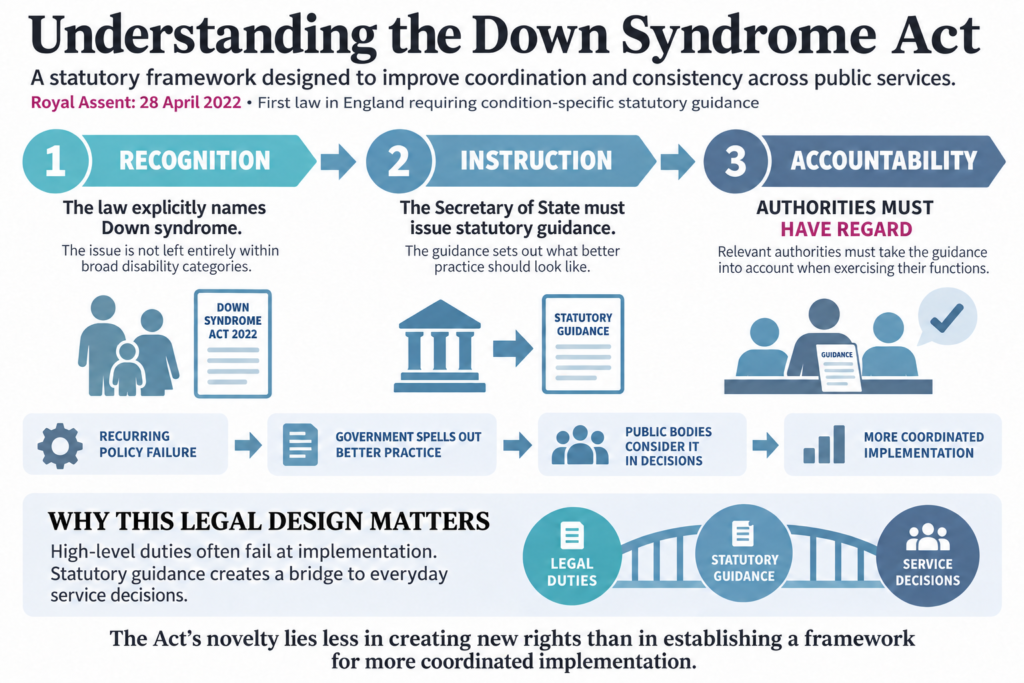
For a non-legal audience, the mechanism is straightforward. Parliament recognised a recurring policy failure. Public bodies were not delivering consistent support across sectors. The response was to create a legal duty requiring the government to spell out what better practice should look like, and then require relevant authorities to take that guidance into account when exercising their functions.
This gives the Act a very different character from a purely symbolic declaration. It turns coordination into a matter of formal public decision-making, making it harder for agencies to ignore or sideline the needs of people with Down syndrome.
A simple way to read the law is through three layers:
Many laws fail at the implementation stage because they announce principles without changing administrative behaviour. The Down Syndrome Act tries to narrow that gap by creating a legal bridge between high-level duties and everyday service decisions.
The Act's novelty lies less in creating new rights than in establishing a statutory framework intended to promote more coordinated implementation across public services.
For international observers, that design choice is the primary point of interest. It suggests a way to legislate for complex, lifelong conditions without pretending that a single law can instantly rebuild every service. Instead, it establishes a framework that can shape how existing systems operate.
The Act's technical function is specific. It requires statutory guidance across defined public-service domains, including the NHS, social care, housing, education, and youth offending, so listed authorities must give due regard to that guidance when exercising their functions, as described in Genetic Alliance UK's overview of the Down Syndrome Act.
For policy analysts, this scope matters because it extends beyond clinical care. The law recognises that outcomes for people with Down syndrome depend on more than medicine alone; they hinge on how multiple systems interact and coordinate.
A useful way to read the Act is by the systems it tries to connect:
| Public-service domain | Why it matters in practice |
|---|---|
| Health | Lifelong monitoring, timely referrals, and coordinated clinical support |
| Social care | Assessments, daily living support, family support, and adult care planning |
| Education | School support, transitions, communication needs, and preparation for adulthood |
| Housing | Future living arrangements, supported housing pathways, and stability in adult life |
| Youth offending | Recognition that some individuals may come into contact with the justice system and require appropriate, tailored guidance |
This broad, cross-sector approach is one of the Act’s most transferable and valuable features. Many countries separate disability policy from housing, or education policy from adult social support. The UK model tries to bring these different domains together under a single statutory framework.
For readers interested in service integration models, Rare Disease Watch's explainer on multidisciplinary clinics for rare diseases is relevant because it illustrates the clinical version of the same problem. The Down Syndrome Act addresses the administrative version, showing how law can be used to connect fragmented systems.
“Due regard” may sound like a legal term, but the practical meaning is straightforward. It does not usually mean an authority must follow the guidance word for word in every circumstance. Instead, it means the authority cannot ignore the guidance, treat it casually, or depart from it without reasoned consideration.
In operational terms, due regard pushes public bodies to do several things:
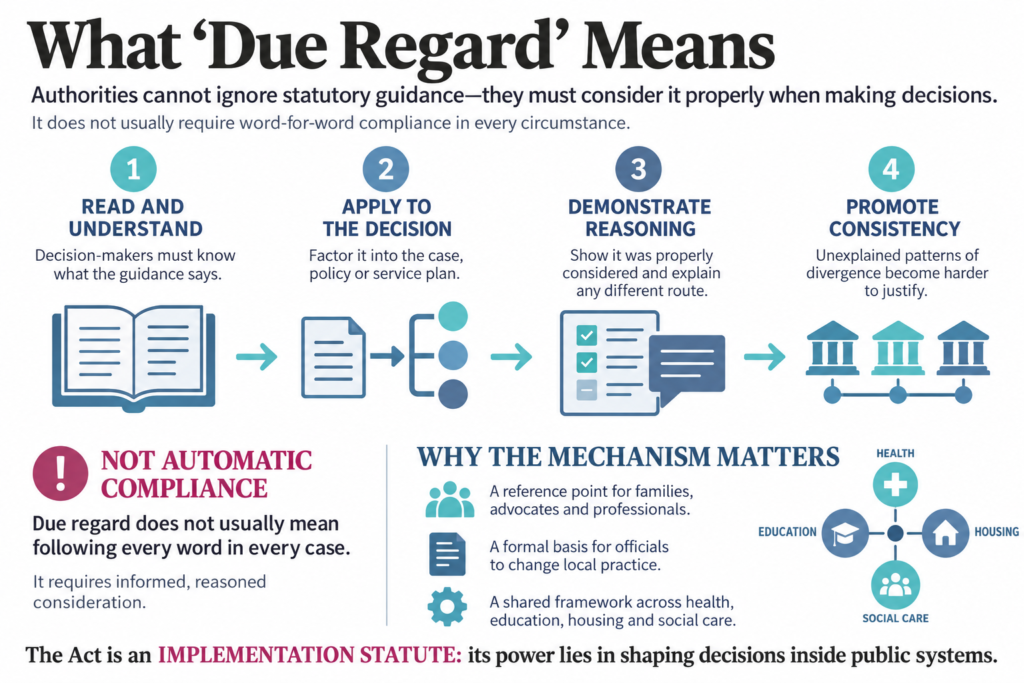
The Down Syndrome Act shifts the focus from symbolic recognition to practical administration. It gives families, advocates, and professionals a reference point when they challenge poor coordination. It also gives officials a formal basis for changing local practice.
This is why the law should be understood as an implementation statute. Its power lies in how it shapes decisions inside public systems, not only in how it sounds in political debate.
The most important test of any framework law is whether it changes what families experience. The government's guidance process for the Down Syndrome Act was intended to improve access to services and quality of life, with a public call for evidence helping to inform the statutory guidance. Once issued, relevant authorities must have regard to that guidance when exercising their functions.
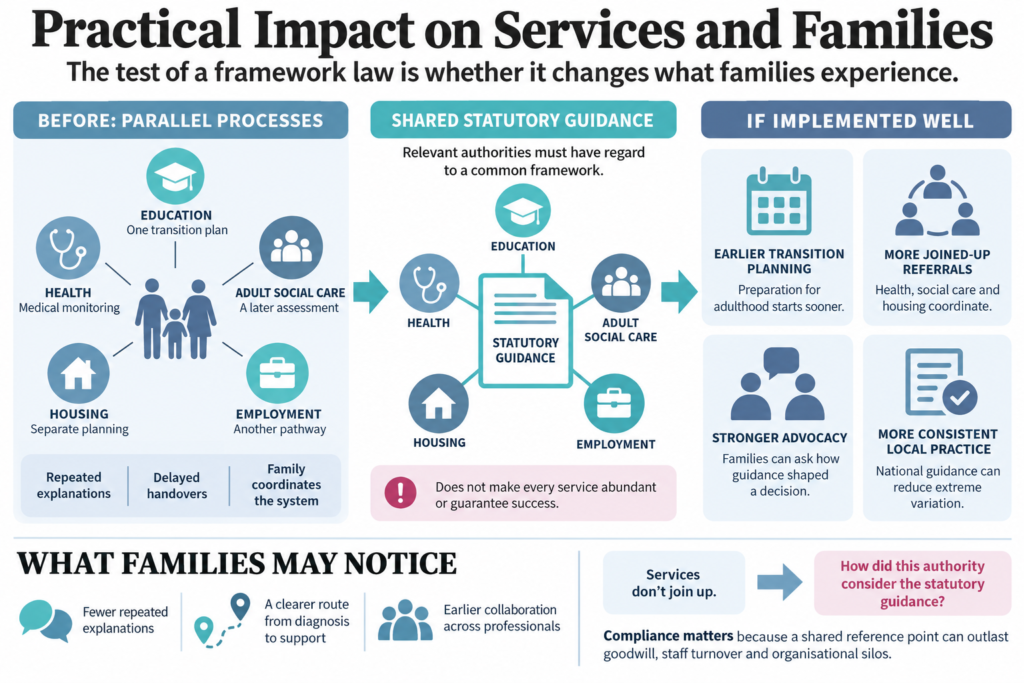
Before this kind of framework, a school leaver might face disconnected processes. Education staff plan one transition. Adult social care starts another assessment later, and health professionals continue monitoring medical needs without connecting them to housing or employment planning.
A guidance-driven system aims to make that pathway more coherent. The change is not that every service suddenly becomes abundant. The change is that each service has a stronger obligation to consider a shared framework, reducing fragmentation and making coordination a formal expectation.
If implemented well, the Act’s framework can produce several tangible effects:
The practical rule is simple: The Act is most useful when it turns a vague complaint, “services don't join up”, into a concrete accountability question, “how did this authority consider the statutory guidance?”
For families, the value of a cross-sector framework often appears in everyday moments rather than headline reforms. It may mean fewer repeated explanations to different professionals, a clearer route from diagnosis to support planning, or earlier collaboration between education, health, and care professionals.
These changes also affect adult life beyond formal services. True inclusion depends on relationships, community participation, and social opportunities, not only on public programmes. For many people with Down syndrome, practical support in building those connections can matter as much as official planning. Resources designed for disabled adults, such as social networking and dating platforms, can complement service‑based support, offering a fuller picture of adult life and autonomy.
The financial impact of fragmented support is also substantial. Delays, repeated assessments, transport burdens, and the demands of informal care often fall first on families. Rare Disease Watch’s analysis of the financial burden explores these wider pressures in detail, showing how systemic gaps translate into everyday costs.
Many public services already rely on committed professionals. But the problem is that goodwill alone does not survive staff turnover, local budget pressures, or organisational silos. A compliance framework matters because it creates a shared reference point for action.
The Down Syndrome Act doesn't guarantee success, but it changes the terms of engagement. Families and advocates have a stronger basis for asking how statutory guidance was considered when decisions are made. They can refer to a statutory process that authorities are meant to consider and, where necessary, justify.
A balanced understanding of the Down Syndrome Act must begin with what it does not claim to do. The government's consultation on the statutory guidance explains that it is intended to help people with Down syndrome as well as others with similar needs. It also makes clear that the Act is not designed to provide enhanced care beyond what comparable disabled people should receive. Whether the Act ultimately reduces fragmentation for people with complex, lifelong needs, or reinforces existing obligations through better coordination, will depend on how consistently the statutory guidance is implemented in practice.
That limitation is not a flaw hidden in the small print. It is an intentional part of the law's design. The Act is an implementation tool, not a promise of preferential treatment.
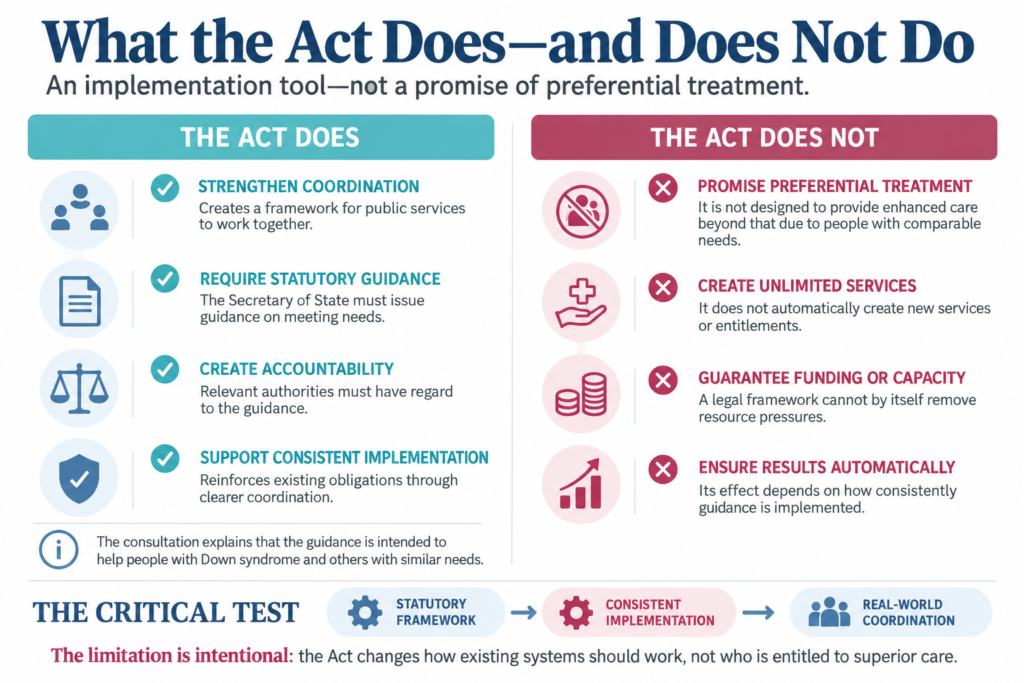
The strongest critique of the Act is practical. While guidance can clarify expectations, improve consistency, and strengthen accountability, it cannot, on its own, create staffing capacity, eliminate waiting lists, or ensure specialist expertise exists in every locality.
This limitation matters especially where needs are complex and ongoing. Down syndrome is associated with a broad set of comorbidities and support requirements across the entire lifespan. Coordinating those needs is hard even in well-organised systems. If local services lack diagnostic pathways, specialist knowledge, or follow-up capacity, guidance may identify the problems more clearly, but it cannot fully resolve them.
A realistic assessment of the Act should ask several hard but necessary questions:
The Act may prove most valuable where local systems are willing but disorganised. It may prove less transformative where systems are already overstretched.
A recurring weakness in public discussion around the Act is the tendency to present it as if it guarantees a complete, personalised package of services for every person with Down syndrome. The available consultation materials made it clear that this is not the intention. The framework is meant to improve how existing duties are applied, including for people with similar needs. That scope is narrower, but also more transparent and realistic.
This distinction matters internationally. Named-condition legislation can generate expectations that no guidance-based law can meet by itself. If advocates present such laws as total solutions, disappointment is inevitable. If they present them as practical tools for administrative alignment and accountability, the policy logic is stronger and more sustainable.
The toughest test of the Down Syndrome Act is not whether it is morally compelling. It clearly is. The real test will be whether a statutory framework can actually reduce the everyday fragmentation that families experience across health, education, social care, and housing.
If it succeeds, then the law will offer a meaningful model for other rare and lifelong conditions. If it falls short, the lesson may be different. Legislatures may need to pair coordination duties with stronger implementation machinery, clearer monitoring, or deeper service reform.
For policymakers and advocates outside the UK, the Down Syndrome Act offers a useful lesson in legislative architecture. It shows that a rare-condition law doesn't have to begin with a new benefit or a new treatment entitlement. Instead, it can start by addressing a more fundamental challenge: Public systems often fail to coordinate around a condition that clearly spans multiple services and sectors.
This is what makes the Act relevant well beyond Down syndrome. Countries developing rare disease strategies, disability reforms, or integrated care policies can study it as a practical model for introducing condition-specific accountability within existing systems.
First, naming a condition can change administrative behaviour. While broad disability law remains essential, some conditions generate distinctive patterns of need that disappear inside generic categories.
Second, guidance can be more important than symbolism. Laws that force practical instruction on public bodies may achieve more than those that only provide general values and principles.
Third, cross-sector design matters. Health services alone cannot resolve challenges rooted in education transitions, housing insecurity, or care fragmentation.
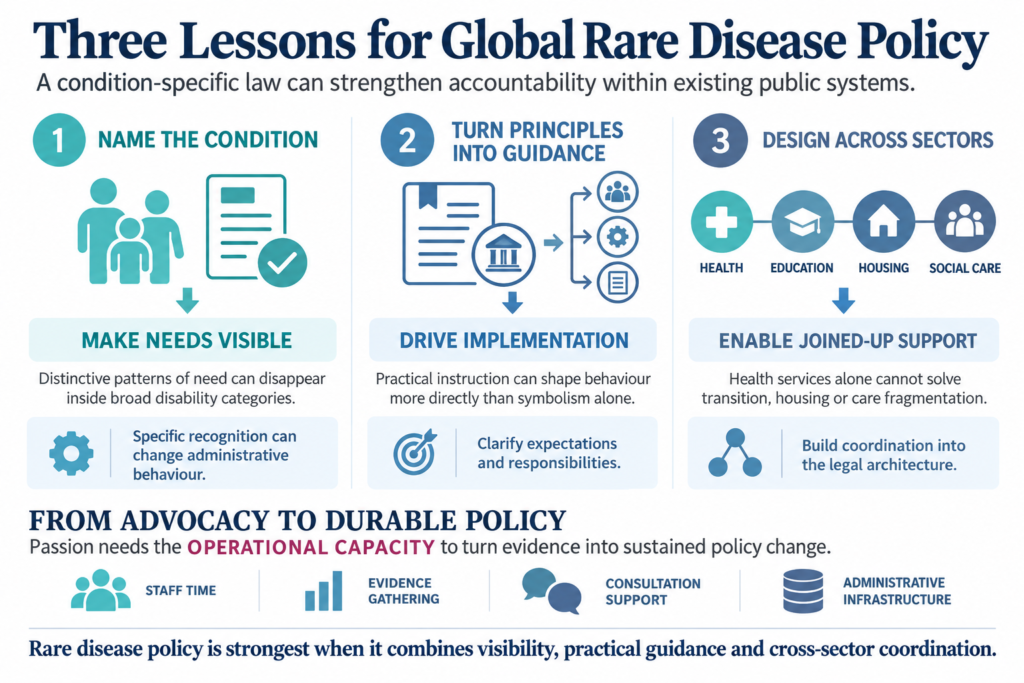
For organisations trying to turn advocacy into meaningful policy change, operational capacity is just as important as passion. Successful campaigns require staff time, evidence gathering, consultation support, and strong administrative infrastructure. Resources on building organisational capacity, such as those provided by the National Council for Voluntary Organisations (NCVO), can help advocacy groups think beyond raising awareness and build sustainable structures needed for long-term effective policy work.
The most instructive feature of the Down Syndrome Act is not that it focuses on a named population, but that it uses law to organise state behaviour around a life-course pattern of need.
That approach raises important strategic questions for other countries:
For readers interested in the wider interaction between legislation and access, Rare Disease Watch's analysis of how health policy shapes access to rare disease treatments provides a complementary lens. Treatment access is one part of the story; Service coordination is another.
The Down Syndrome Act should therefore be understood as more than a national legal milestone. It is a working experiment in how governments might legislate for rare, lifelong, cross-system needs without pretending that one single statute can fix everything. As a global blueprint, it remains incomplete. As a policy case study, it is highly instructive, showing how legislative design can turn coordination itself into a statutory duty.
Whether or not other countries ultimately adopt similar legislation, the Down Syndrome Act provides one of the clearest contemporary examples of how law can be used to improve coordination across public services. For policymakers, clinicians, advocates, and rare disease organisations, it offers a valuable case study in translating lived experience into more accountable, integrated systems of care.