Caring for a child with a rare disease can be deeply rewarding, but it can also place significant emotional, psychological, financial and practical demands on parents and caregivers. Rare diseases often involve complex medical needs, uncertain prognoses, frequent healthcare appointments and ongoing advocacy for specialist services. These challenges can affect every aspect of family life.
Research consistently shows that parents of children with rare diseases experience higher levels of stress, anxiety, social isolation, and reduced quality of life compared with the general population. However, evidence also suggests that support systems, self-care strategies, and reliable information can significantly improve resilience and wellbeing.
This article explores the emotional impact on parents raising children with rare diseases and conditions, and offers practical self-care strategies, support systems, and resources to help families navigate uncertainty with resilience and care.
A rare disease diagnosis can arrive suddenly or emerge gradually after years of uncertainty. For many families, it follows a prolonged process of repeated GP visits, referrals, inconclusive tests, and conflicting specialist opinions.
There are approximately 7,000 known rare diseases worldwide, affecting an estimated 300 million people globally and over 3.5 million people in the United Kingdom. Around 72% of these conditions affect children.
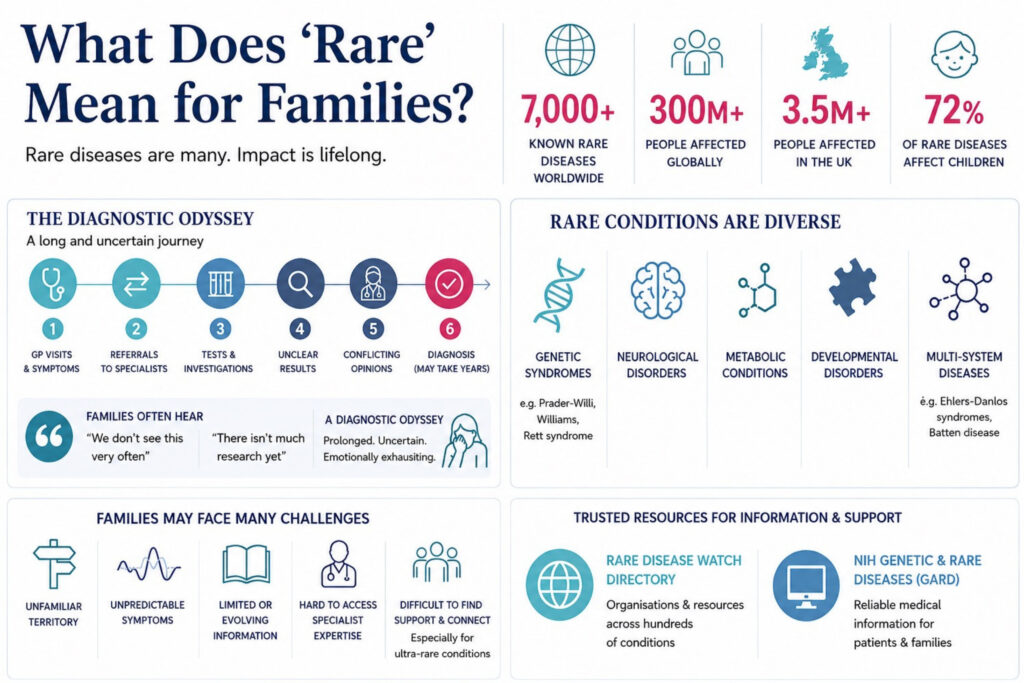
Families often hear phrases such as:
“We don’t see this very often”
“There isn’t much research yet”
This experience is widely recognised in rare disease literature as a diagnostic odyssey a prolonged and emotionally exhausting pathway to diagnosis. For more on the diagnostic process, see Genetic Alliance UK and Rare Disease Watch's Glossary.
Many parents describe feeling overwhelmed when they learn that there may be limited research, few treatment options, or a lack of local expertise related to their child's condition.
Rare conditions span a wide range, including:
For condition-specific information, the Rare Disease Watch Directory lists organisations and resources across hundreds of conditions. The Genetic and Rare Diseases Information Center (GARD) maintained by the NIH is also a reliable starting point for families seeking medical information.
As a parent, you may find yourself navigating unfamiliar territory where symptoms can be unpredictable, information may be limited or continually evolving, and specialist expertise can be difficult to access. Finding clear support pathways or connecting with other families who share similar experiences can also be challenging, particularly for those affected by ultra-rare conditions.
Parenting a child with a rare disease often means stepping away from traditional developmental expectations.
There may be:
Instead, many parents develop expertise through lived experience, adapting constantly to their child’s needs.
Over time, families often learn to:
For further reading on navigating life after diagnosis, see Coping As A Family After A Rare Disease Diagnosis on Rare Disease Watch.
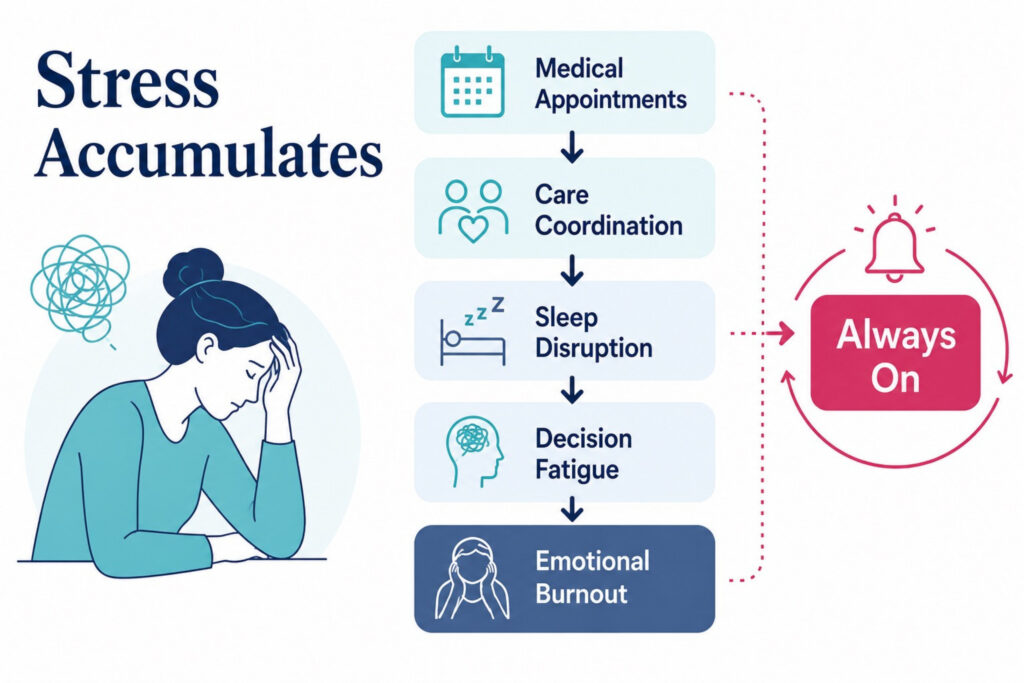
Several distinct pressures combine to make this experience different from other caregiving roles. They rarely arrive one at a time, which is part of why the cumulative strain can build before parents notice it.
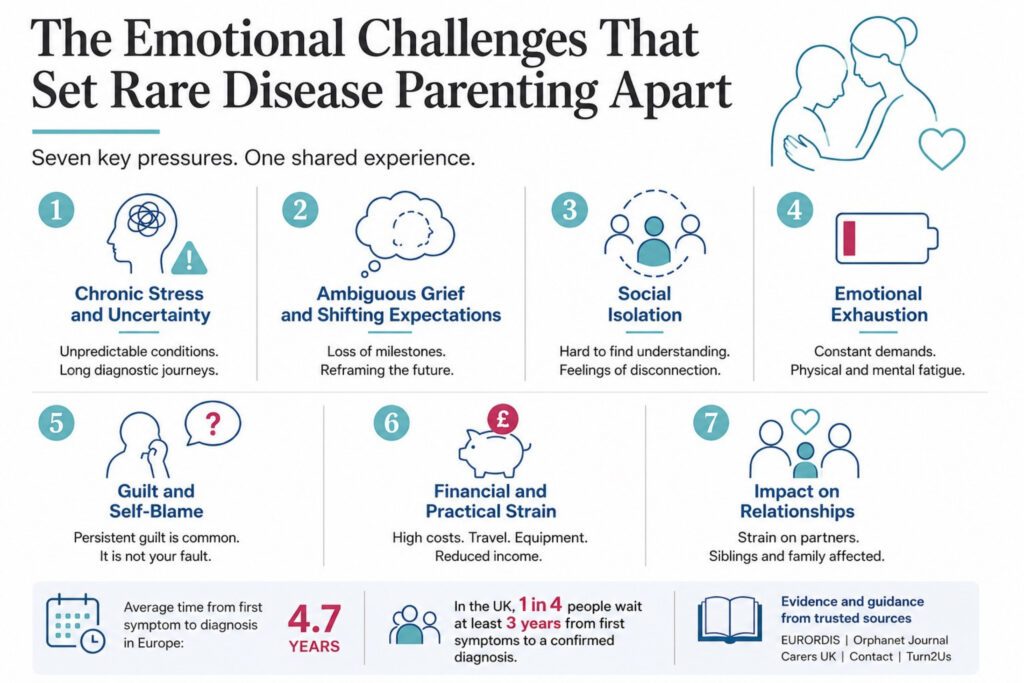
Rare conditions are unpredictable by nature. In Europe, the average time from first symptom to confirmed diagnosis is around 4.7 years. In the UK, roughly 1 in 4 people wait at least three years from first symptoms to a confirmed diagnosis, according to data from EURORDIS — Rare Diseases Europe.
During this period, parents manage their child's symptoms while simultaneously processing their own response to the unknown. This creates a sustained state of vigilance -an "always-on" anxiety that is physiologically and emotionally depleting.
Parents of children with rare diseases report higher rates of anxiety, depression, and trauma-related symptoms than parents of children without complex needs. Disrupted sleep compounds this further, creating a cycle where physical exhaustion feeds emotional vulnerability. See the EURORDIS caregiver survey findings for further data on caregiver burden across rare disease groups.
Parents of children with rare diseases frequently experience ambiguous grief associated not with physical loss, but with the loss of expectations. This may include:
Ambiguous grief is real, valid, and often goes unacknowledged by those around the family. For broader context on the psychological impact of rare disease, the Orphanet Journal of Rare Diseases publishes peer-reviewed research accessible to families and professionals.
Because rare diseases are uncommon, many parents find it genuinely difficult to connect with others who understand their experience. Social isolation can develop through:
Even supportive friends and family members can sometimes say things that widen the emotional distance, simply because they lack the context to understand. Even well-intentioned responses from others can sometimes feel minimising, contributing to emotional distance.
Balancing caregiving, medical coordination, employment, and family life can produce profound and cumulative fatigue. Many rare disease parents effectively become lay medical experts out of necessity spending significant time researching, co-ordinating care, and preparing for appointments.
This creates a form of caregiver burden that combines emotional stress with intellectual demands and decision fatigue. Sleep disruption caused by worry, medical appointments, and caregiving demands creates a cycle where physical exhaustion compounds emotional vulnerability. For a broader understanding of caregiver burnout, Carers UK offers practical guidance and self-assessment tools.
Many parents of children with rare diseases report persistent guilt questioning whether something they did or did not do contributed to their child's condition. For parents of children with genetic conditions, this can carry an additional dimension of self-questioning that, while unfounded, feels intensely personal.
Guilt of this kind is extremely common and does not reflect reality. It does, however, require acknowledgement rather than dismissal.
Rare disease caregiving frequently involves:
Research consistently highlights higher-than-average healthcare-related costs and indirect financial burden for rare disease families. Contact for families with disabled children provides detailed guidance on financial support and benefits available in the UK. Turn2Us offers a free benefit and grant search tool for families in financial difficulty.
Rare disease caregiving affects the entire household. Common challenges include:
For guidance on supporting siblings and partners, see Supporting Your Child's Mental Health Through Chronic Illness on Rare Disease Watch, and Sibs is a UK charity supporting people who grow up with or have a disabled sibling.
Evidence from rare disease organisations and academic studies consistently shows:
For a peer-reviewed overview, the Orphanet Journal of Rare Diseases and NORD (National Organization for Rare Disorders) provide accessible research summaries.
Research also acknowledges important limitations: many studies are small or condition-specific, long-term data across rare disease groups is limited, and interventions are not always tailored to the full complexity of rare disease experience. The evidence base continues to grow.
Because emotional strain is invisible on a scan, recognising it usually comes from one of three directions:
There is no threshold of "bad enough" you must reach before reaching out. If your sleep, mood, relationships, or daily functioning are affected, that is reason enough.
If you ever feel unable to cope, or have thoughts of harming yourself, contact your GP, call NHS 111, or in an emergency call 999.
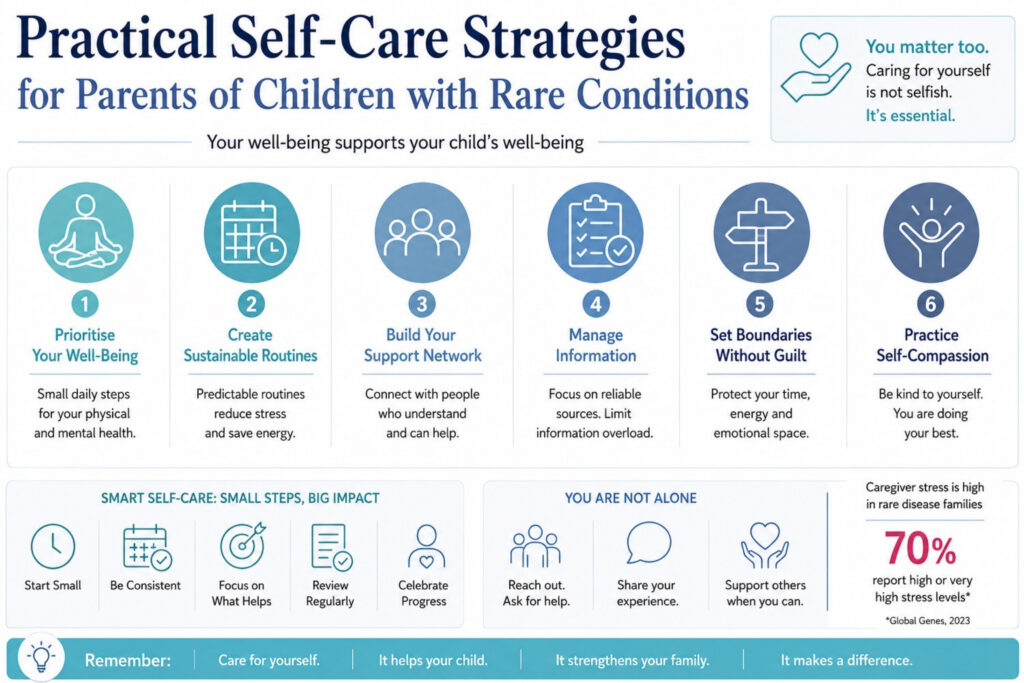
Sustainable self-care does not require long stretches of time. For rare disease parents, consistency matters more than duration.
Scheduling self-care activities the way you would schedule a medical appointment makes them harder to skip. A 15-minute morning walk, an evening breathing practice, or a weekly creative activity can each provide meaningful restoration when practised regularly.
Why this works: Even 15 to 20 minutes of daily physical activity has been shown to reduce cortisol levels and improve mood regulation. Predictable routines also reduce decision fatigue a significant and often underestimated burden for complex caregivers. The Mental Health Foundation publishes free guidance on mental health for carers.
Where to start:
Boundary setting is a core self-care skill for rare disease parents. Emotional energy is finite, and without intentional boundaries, it is easily depleted by well-meaning but draining conversations, unrealistic expectations, and over-commitment.
Boundaries may include:
Boundaries with your medical team are equally valid. It is appropriate and healthy to tell a specialist that you need information presented differently, or that a meeting needs to be rescheduled. Carers UK's helpline can offer guidance on assertive communication with services.
Research into caregiver wellbeing consistently identifies one underused resource: help that is already available.
Parents of children with rare conditions often decline offers of support because of guilt, habit, or uncertainty about what to ask for. Accepting practical help meals, sibling childcare, household tasks, lifts to appointments reduces emotional overload without requiring you to seek anything out yourself.
Try this: The next time someone asks "Is there anything I can do?", have a ready answer prepared. A concrete ask ("Could you collect the kids on Thursday?") is easier for both of you than a vague "I'll let you know."
For parents who need more structured help with daily tasks, Carers Direct (NHS) provides guidance on arranging carer support through local authorities.
Generic parenting support, while valuable, rarely addresses the specific experience of raising a child with a rare or undiagnosed condition. Parents in this situation benefit from two distinct types of support network:
Connecting with other parents who share your experience is one of the most consistently valued forms of support and reduced isolation is directly linked to better caregiver wellbeing.
Online communities, patient organisation forums, and condition-specific groups offer practical advice, emotional validation, and a sense of being genuinely understood that friends and family, however caring, may not be able to provide.
If you’re unsure where to begin, these organisations and resources may help:
A robust professional support network should include both medical and mental health components. Where possible, establish relationships with a social worker, a patient advocate, and a mental health professional experienced in chronic illness or rare disease caregiving.
For a comprehensive overview of available resources, visit the Rare Disease Watch Resources Hub.
Much emotional strain is driven by practical load. Help with care coordination, respite (short breaks), a carer's assessment, financial advice and workplace flexibility can all reduce pressure. UK families may be entitled to practical, emotional and financial support, and many countries now recognise carers' rights.
In the UK, families affected by rare disease may be entitled to:
For additional financial guidance:
If you are unsure where to start, ask your child's key worker or GP to refer you to a social worker. You do not have to navigate this alone.
For more on policy and funding relevant to rare disease families, see Policy and Regulation on Rare Disease Watch.
Physical self-care forms the foundation of everything else. It is also the area most likely to be neglected during medical crises.
Sleep: Disrupted sleep is extremely common in rare disease households. Where possible, establish consistent bedtime routines, limit screen time before sleep, and if you have a partner alternate nighttime caregiving responsibilities. Even partial improvement in sleep quality has a measurable effect on emotional resilience and cognitive function. NHS Sleep guidance offers practical, evidence-based tips.
Nutrition: Simple, prepared meals eaten at regular intervals stabilise mood and energy more effectively than irregular eating. Batch cooking during stable periods provides a practical buffer during difficult ones. NHS Eatwell Guide is a reliable free resource.
Exercise: You do not need a gym, a structured programme, or significant free time. A 15 to 20 minute daily walk is clinically meaningful. Exercise is one of the most effective available interventions for anxiety and low mood with no waiting list and no referral required. NHS physical activity guidelines for adults explain the evidence simply.
When emotional distress is significant, professional support is not an optional extra it is a clinical need.
Therapists and psychologists familiar with medical trauma, chronic illness, and caregiver stress offer interventions specifically suited to your situation. Options include:
Additional mental health resources:
If you are unsure where to start, speak to your GP or ask your child's care team whether a psychology referral is available through the specialist service.
What works during a period of relative stability may not be sufficient during a medical crisis and what feels essential during a crisis may become less urgent once things settle.
Regular, honest self-assessment of your own emotional wellbeing helps you identify when your current strategies need adjusting and when additional support is required. This does not need to be formal: a brief weekly check-in with yourself (or with a partner, friend, or therapist) is enough to catch problems before they escalate.
Questions worth asking yourself:
Carers UK's self-assessment tool can help you identify areas where additional support may be needed.
Rare disease journeys are long, unpredictable, and punctuated by setbacks. No self-care strategy eliminates that reality.
What self-care does is build the resilience needed to keep going not by denying difficulty, but by ensuring you have enough in reserve to face it. Sustainable caregiving is not a destination. It is a practice, adjusted over time, supported by others, and deserving of exactly the same attention you give to your child's care.
For related reading, see Palliative and Supportive Care for Rare Disease Families on Rare Disease Watch.
There is no perfect way to do this. Many parents of children with rare diseases carry an extraordinary level of knowledge, commitment, and love and still find it hard. That is not contradiction; it is simply the reality of the situation.
What research consistently shows is that support makes a measurable difference. Peer connection, practical help, and appropriate clinical care each improve wellbeing and long-term caregiving capacity. You do not need to find all of it at once. Start with one step.
Asking for help is a sign of strength, not failure. No family should have to navigate the rare disease journey alone. If you are not sure where to begin the organisations listed in this guide are a good place. So is your GP. So is telling one person, honestly, how you are doing.