When Violet's family began looking for answers about her communication, they could see a child with much to share. Finding the right support, however, took time, assessments and conversations with professionals.
Her parents, Randy and Sophia, did that work together. While Randy was still working in construction, Sophia carried much of the day-to-day load of assessments, doctor's appointments and therapies. After he retired, both moved into advocacy Sophia works with Apraxia Kids and Randy with the Skraban-Deardorff community, and each supports the other's work.
Their experience as a family also inspired Violet's Spark, an initiative encouraging understanding of communication differences and rare conditions, which both parents have carried forward.
Violet's family first sought help when she was 16 months old. Although she had plenty to communicate, expressing herself through speech was difficult. The family began navigating assessments and speech therapy while trying to understand what support would best meet her needs.
At four and a half, Violet was diagnosed with diagnosed with childhood apraxia of speech (CAS), a motor speech disorder that affects the planning and coordination of movements needed for speech. The diagnosis helped her family and professionals focus on her particular communication challenges.
The two of them approached that period as shared work. While Randy was still working in construction, Sophia took on much of the managing of Violet's assessments, medical appointments and therapies. Her contribution was an essential part of the family's efforts to find answers and support Violet's development.
They also explored Augmentative and Alternative Communication (AAC), which includes a range of ways to communicate beyond spoken words, such as gestures, communication boards and electronic devices. Information and community resources from Apraxia Kids helped the family learn more about childhood apraxia of speech.
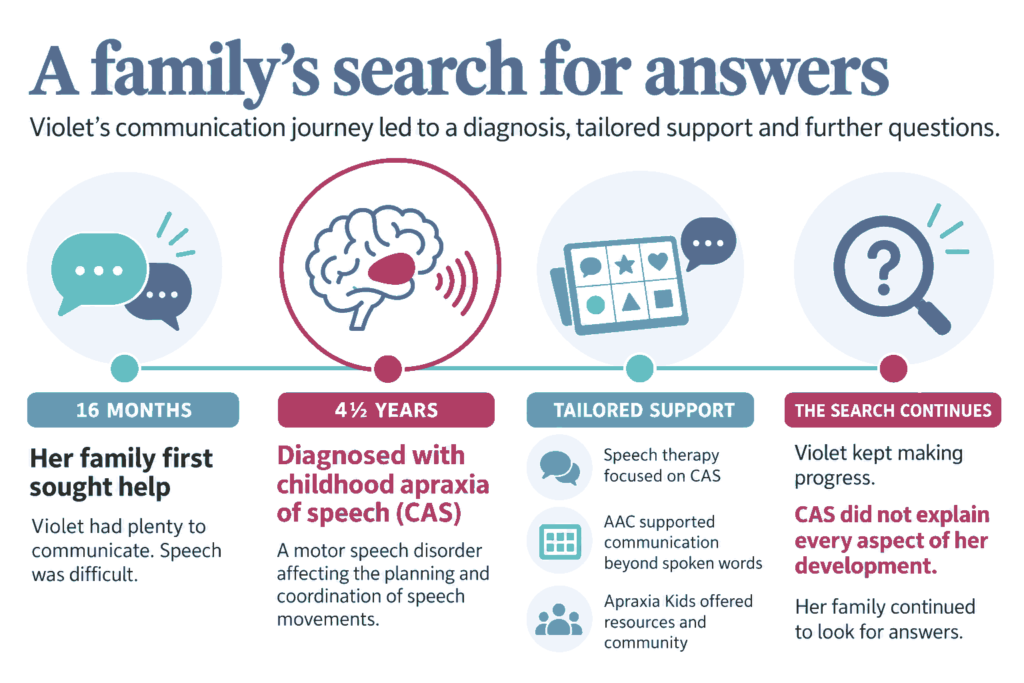
Violet continued to make progress with support tailored to her communication needs. Her family describes her as sweet, vibrant and full of personality. She enjoys playing with other children and wants to participate in the everyday experiences that matter to her.
Yet the diagnosis of childhood apraxia of speech did not explain every aspect of her development. Her family continued to look for answers.
At six, Violet underwent more comprehensive genetic testing. The results identified Skraban-Deardorff syndrome, also known as WDR26-related disorder.
Skraban-Deardorff syndrome is a rare genetic condition associated with developmental differences and a range of neurological and physical features. It can affect speech, learning, movement, muscle tone and feeding, among other areas. Experiences vary considerably from person to person.
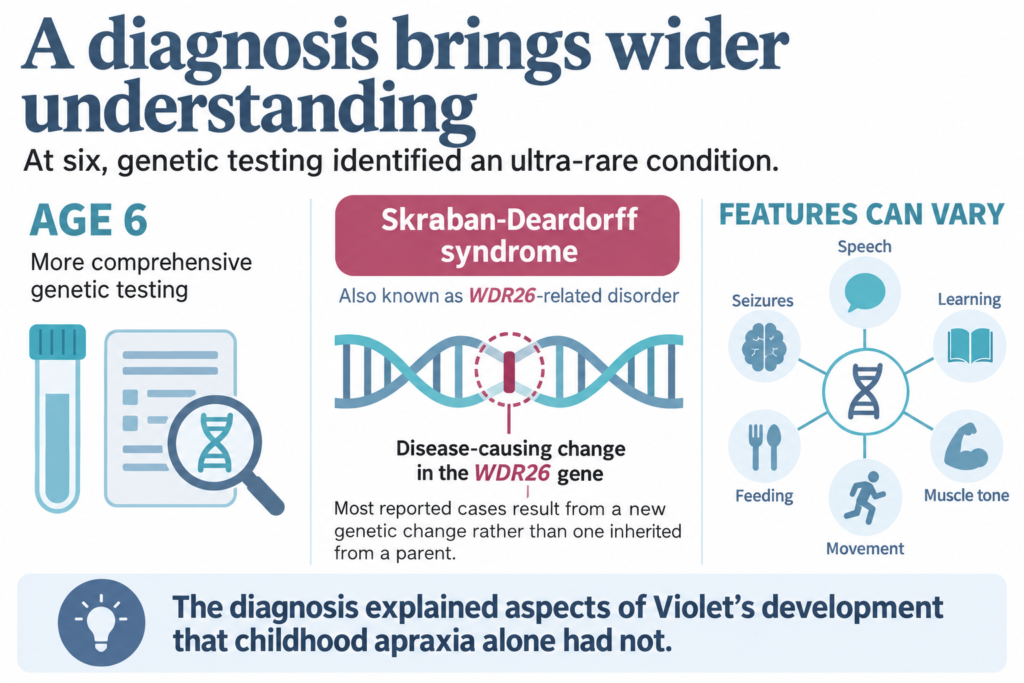
For Violet's family, the diagnosis provided a broader explanation for aspects of her development that childhood apraxia alone had not accounted for. It also introduced them to a rare disease community in which families, clinicians and researchers are still building knowledge about the condition.
For many families affected by rare diseases, reaching a diagnosis can be a long and uncertain process. Some receive several diagnoses before the wider picture becomes clear. Others spend years seeking an explanation for symptoms that do not fit neatly into a single clinical description.
Violet’s experience illustrates why appropriate assessment, access to relevant expertise and awareness of rare genetic conditions matter. A diagnosis does not answer every question, but it can help families find condition-specific information, connect with others and explore appropriate support.
Violet's story also highlights an important distinction between speech and understanding.
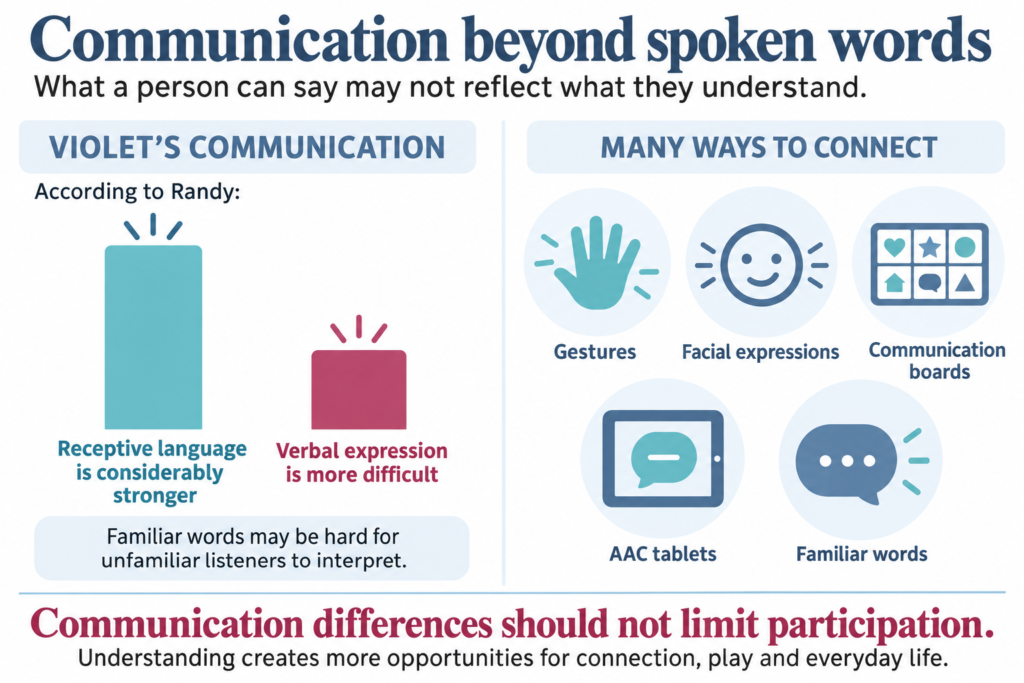
For Violet, understanding and expressing herself are two different parts of communication. In an interview with Rare Disease Watch, Randy and Sophia explained that she has stronger receptive language skills than verbal expression. Some of her familiar words may not always be easy for others to understand, but her enthusiasm for connecting with people is unmistakable.
Communication can take many forms. Spoken words are one way to express ideas and preferences; gestures, facial expressions, communication boards and AAC devices can also support participation.
When people take time to understand how someone communicates, they help create opportunities for that person to be included in conversations, relationships and everyday activities.
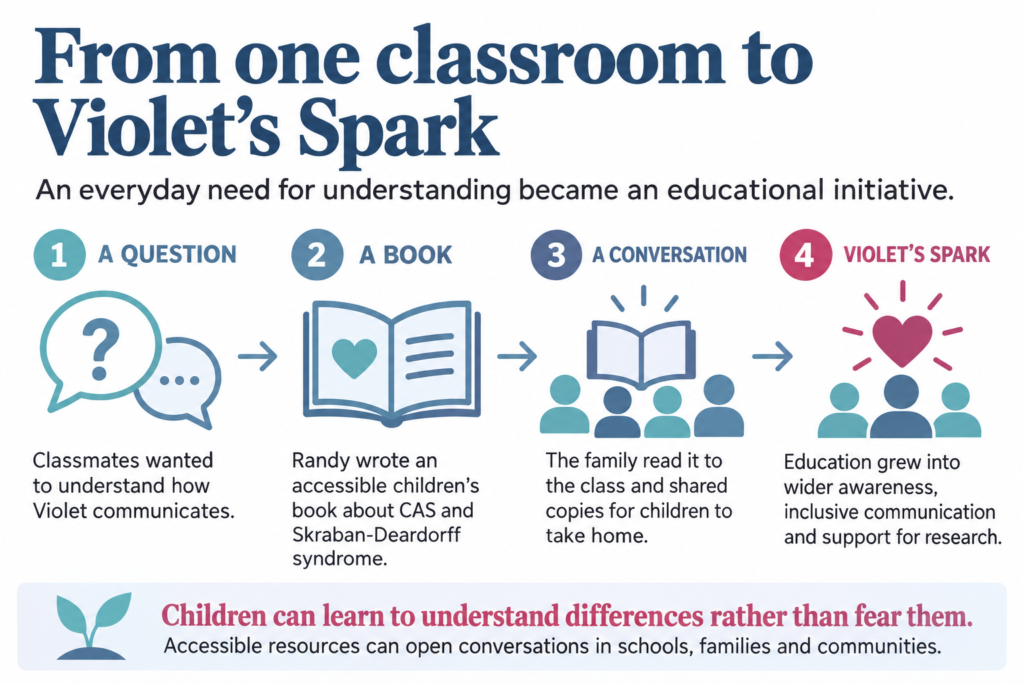
Randy saw the importance of this while volunteering in Violet's classroom. Her classmates wanted to understand her, while their parents had questions about her condition. He and Sophia recognised an opportunity to make those conversations easier.
Randy began writing an educational children’s book to help Violet’s classmates learn about childhood apraxia of speech and Skraban-Deardorff syndrome. He and Sophia read it to the class and provided copies for families to take home, giving children and parents a way to carry on learning and talking together about communication differences. Building Bridges with Violet
“What began as a way to help Violet's classmates understand her has become an opportunity to help more families, schools and communities understand rare disease and communication differences.”
That idea grew into Violet’s Spark, the initiative Randy and Sophia built from it, promoting understanding of creative communication while supporting rare disease research and speech therapy foundations. Its educational resources introduce children, families, schools and communities to different communication methods, and its Education Hub is where those materials can be found.
The idea behind the initiative is straightforward: children should have opportunities to understand differences rather than fear or misunderstand them.
For Violet, this means an environment in which her classmates can learn how she communicates and how they can include her in play. For other families, accessible educational resources offer a starting point for conversations that might otherwise feel difficult.
When Randy retired after more than 30 years in construction, the family's advocacy took on a new shape. Both parents began dedicating time to it, each in the area they had come to know best.
Randy immersed himself in scientific publications, conferences and research terminology to better understand the questions facing the Skraban-Deardorff community.
His aim was not to replace clinical expertise, but to become better equipped to engage with researchers and contribute to conversations about the needs of families.
Randy has joined the board of the Skraban-Deardorff Syndrome Foundation, serving as chair of its development committee and contributing to its medical advisory work.
The foundation works to advance understanding of the condition through research, education and collaboration among families, clinicians and scientists. Its research programme includes work in neurodevelopmental assessment, basic science and drug discovery, alongside efforts to develop research resources and models that may support future investigations.
Sophia's work runs in parallel. She works with Apraxia Kids, the organisation whose information and community resources had helped the family make sense of childhood apraxia of speech in the first place, and Randy supports that work as she supports his in the Skraban-Deardorff community.
Neither strand stands on its own. Between them, Randy and Sophia cover ground that neither could manage alone, from the practical work of navigating appointments and therapies to building understanding within wider communities.
For families affected by an ultra-rare condition, research progress depends on many interconnected efforts: understanding the condition's natural history, identifying and connecting affected individuals, developing meaningful outcome measures and establishing the evidence required to evaluate potential treatments.
Family participation is valuable throughout this process. Lived experience helps researchers understand which aspects of daily life matter most, and families often contribute information that improves the overall picture of the condition.
Patient advocacy is not limited to campaigning or fundraising. It can include sharing experiences, improving public understanding, helping families find trusted information and contributing to conversations about research priorities.
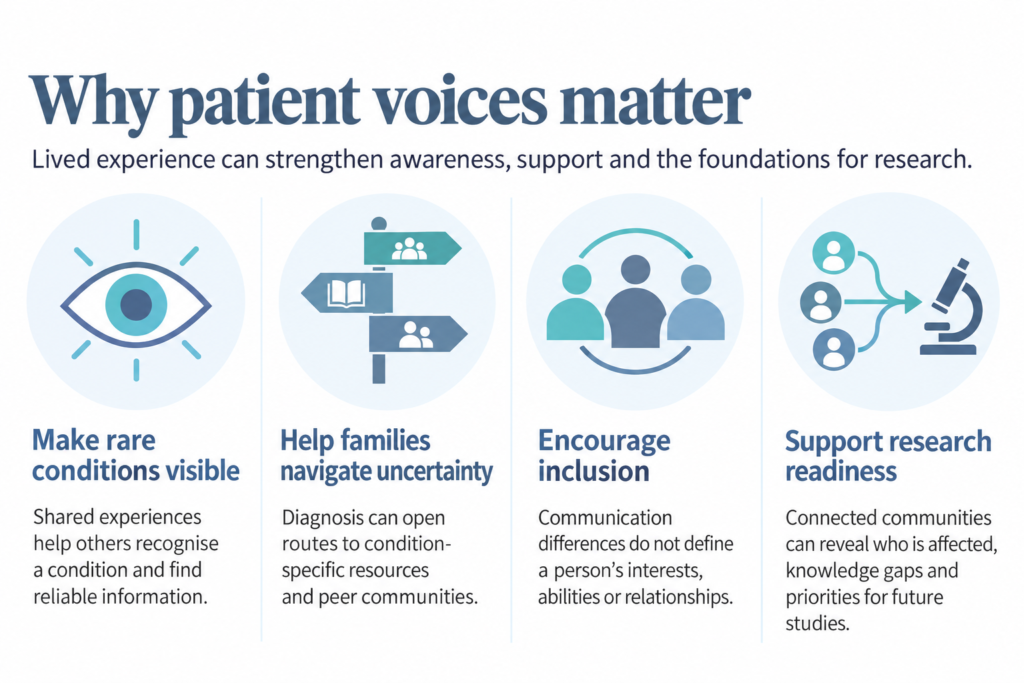
Violet’s story highlights several ways that lived experience can make a difference.
Making rare conditions visible. When families share their experiences, they help others recognise that a condition exists and learn where to find reliable information. Greater awareness may also encourage more informed conversations between families and healthcare professionals.
Helping families navigate uncertainty. A diagnosis can open a route to condition-specific resources and peer communities. Family-led organisations can help people understand where to look for information while recognising that individual medical questions require qualified clinical advice.
Encouraging inclusion. Education can help classmates, teachers and wider communities understand that communication differences do not define a person’s interests, abilities or relationships.
Supporting research readiness. Connecting families and improving awareness of a rare condition may help research communities understand who is affected, identify gaps in knowledge and build the foundations needed for future studies.
These contributions are complementary. Awareness alone cannot guarantee a diagnosis, better treatment or research funding. However, it can help create the conditions in which families are more visible, information is easier to find and collaboration becomes possible.
Skraban-Deardorff syndrome remains ultra-rare, and knowledge about its full range of features continues to develop. For families, this can mean navigating uncertainty while trying to understand what a diagnosis may mean for their child.
The Skraban-Deardorff Syndrome Foundation provides condition-specific information and details of its family, research and educational activities. Its work offers a route for families and professionals seeking a more detailed understanding of the syndrome.
Violet’s Spark complements this work through accessible awareness and education resources, particularly for schools, relatives and community members who may be encountering the condition for the first time.
Rare Disease Watch connects readers with organisations and resources through its directory listing for Violet’s Spark. Making these connections easier to find is part of a wider effort to reduce fragmentation and help families navigate the rare disease information landscape.
Each organisation has a distinct role. Condition-specific foundations provide specialist knowledge and research updates, while educational initiatives help translate lived experience into accessible conversations within families, schools and communities.
Violet's story began with a family searching for answers about her communication. It has since become part of a wider effort to improve understanding of an ultra-rare condition, and to show why inclusion matters.
Obtaining a diagnosis was only one part of it. The rest is about relationships, curiosity, family commitment and the ways people learn to understand one another.
That work has drawn on both parents. Sophia coordinated much of Violet's care before Randy retired, and their continuing involvement in the Skraban-Deardorff and apraxia communities builds on that shared experience.
Their advocacy grew from an observation in Violet's classroom: her classmates wanted to connect with her, but they needed help understanding how. Through Violet's Spark, Randy and Sophia turned that conversation into an invitation to learn about different ways of communicating one that now reaches well beyond a single classroom.
At Rare Disease Watch, patient and family stories are an essential part of raising awareness. They bring lived experience into conversations that might otherwise focus only on diagnoses, symptoms and research terminology, and they remind us that every individual has a life beyond a medical record. Understanding a rare disease begins with understanding the people who live with it. By listening to families, sharing reliable information and recognising different ways of communicating, we can help build communities in which rare conditions are better understood and people are more readily included.
